 Passive understanding vs active speaking Vietnamese · Linh · Eosling
Eosling Linh Blog Passive understanding vs active speaking Vietnamese
From Understanding to Speaking Vietnamese: A Practical Bridge — Vietnamese Lessons
You understand Vietnamese but freeze when it's your turn to speak. Learn Vietnamese online and move from passive listening to real sentences, step by step. Vietnamese Lessons.
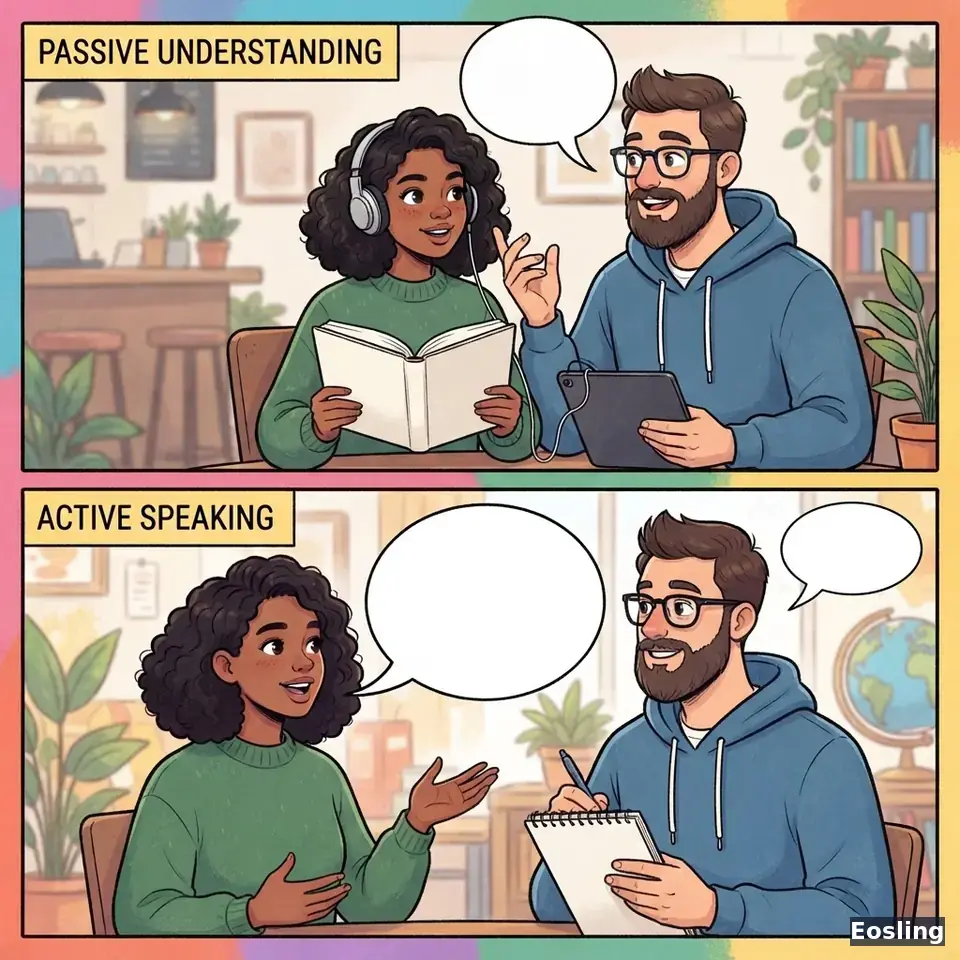
Students often tell me the same thing: "I watch Vietnamese videos and get almost everything, but when someone asks me a question, my mind goes blank." I hear you. Understanding Tôi đang ăn cơm the moment you read it is one skill. Producing Tôi đang ăn cơm yourself, out loud, at the right moment, is a completely different one. This article is about building that second skill without pretending it's easy — the practical bridge you cross when you learn Vietnamese online.
Vietnamese practice
Pronunciation practice
Listen to the phrase, repeat into the mic — your teacher analyzes the audio and gives a real pronunciation score with corrections and comments.
1 / 3
Xin chào, bạn khỏe không?
hello, how are you?
Why can we understand but not speak?
Recognition is fast and forgiving. When you read Anh ấy đã đi Hà Nội hôm qua, your brain matches patterns you've seen before — no output required. Production is slower: you must retrieve a word, pick a tense marker, order the sentence, and pronounce it, all at once. Vietnamese adds its own hurdles. There are no verb conjugations to lean on, so word order and particles like đã, đang, sẽ carry the timeline. Tones must be produced, not just recognised. And many learners freeze because they're translating word-by-word from English instead of reaching for a ready-made chunk.
| English idea | What learners say (wrong) | Natural Vietnamese |
|---|---|---|
| I already ate | Tôi ăn rồi đã | Tôi ăn rồi |
| I am going to school | Tôi đi sẽ trường | Tôi sẽ đi học |
| Do you understand? | Bạn hiểu không? (fine!) | Bạn có hiểu không? |
Notice the middle row: the learner grabbed English future logic and stacked sẽ in the wrong place. The fix isn't more grammar rules — it's repetition of correct chunks until they surface automatically.
Turning what you understand into what you say
Start with recycling, not inventing. Pick three expressions you hear constantly — Không sao đâu, Để tôi xem, Thật à? — and say them aloud until they're yours. Then retell a short message in simpler words: if a friend says Mai tôi phải đi làm sớm, you repeat back À, mai bạn đi làm sớm. You're not adding new grammar; you're converting input into output.
Another trick: complete sentence beginnings. I give students a stem like Hôm nay tôi muốn… and they finish it aloud, even badly. Hôm nay tôi muốn uống cà phê is a real sentence, and it came from you. Answer familiar questions too — Bạn tên gì?, Bạn ở đâu?, Bạn thích ăn gì? — out loud, daily, until the answer arrives without translation.
Comments
Article discussion: learner comments and Eosling teacher replies
Drop your emotions below — love, debates, even hate welcome. Comment 👇
Don't want to miss my reply? Leave your email — I'll send a copy.