 Linh · Eosling
How to Stop Translating in Your Head and Start Thinking in Vietnamese — Learn To Speak Vietnamese
Why your brain keeps translating English into Vietnamese before you speak, when that habit helps, and practical drills to learn Vietnamese online with direct thinking. Learn To Speak Vietnamese.
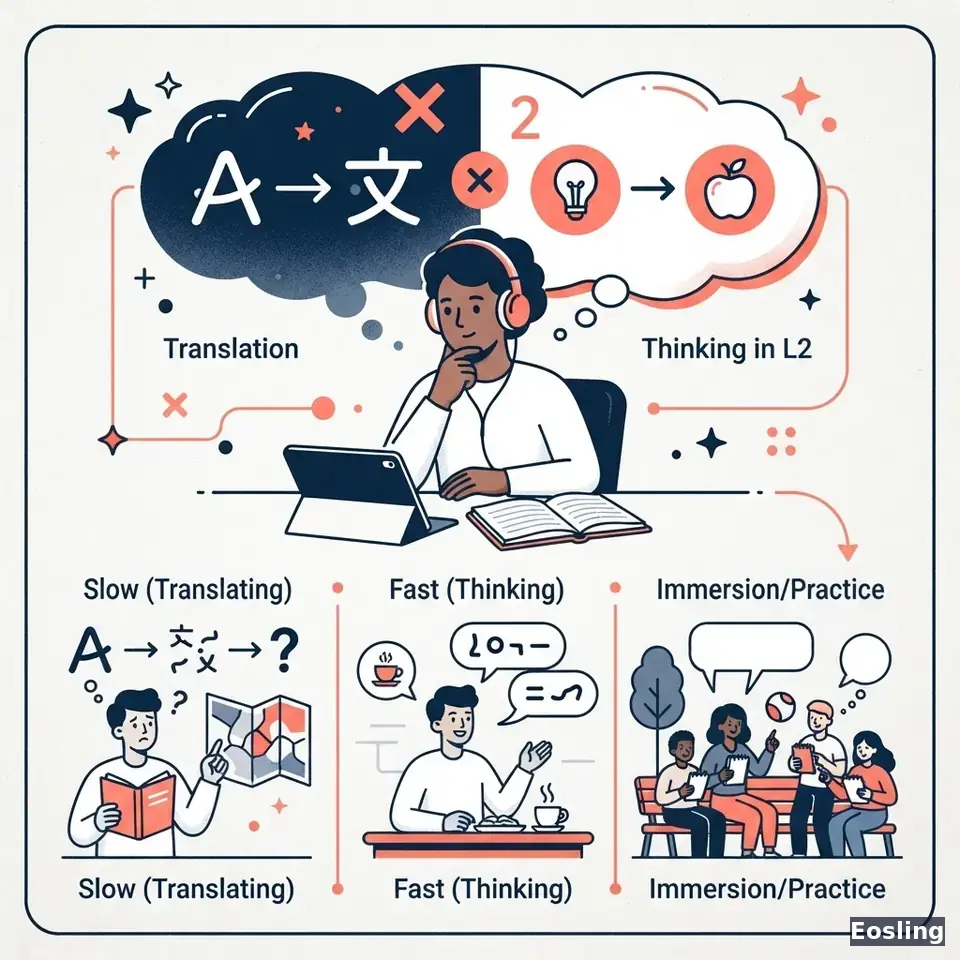
Every learner I meet eventually confesses the same thing: before saying a sentence in Vietnamese, they build it in English first. I hear it in the pauses — the student wants to say Tôi thích uống cà phê but the gears are visibly turning: I… like… drink… coffee. The words arrive, just late. That lag is the translation habit, and it's completely normal. My job isn't to shame it out of you; it's to help you shrink it, sentence by sentence — and if you learn Vietnamese online, you can practise that shrinking in small, low-pressure sessions.
Vietnamese practice
Pronunciation practice
Listen to the phrase, repeat into the mic — your teacher analyzes the audio and gives a real pronunciation score with corrections and comments.
1 / 3
Xin chào, bạn khỏe không?
hello, how are you?
Why does your brain keep translating? — Everyday Vietnamese conversation
Your native language is a well-worn highway. When you need a word, English hands it over instantly. Vietnamese has to be fetched, checked, and slotted in — so the brain takes the shortcut and routes everything through English first. At beginner level this is unavoidable: you simply don't own enough Vietnamese yet to think in it. The real shift happens when chunks become automatic. A phrase like
When translation helps, and when it gets in the way
Translation is a legitimate learning tool, especially early on. Checking a new word against English, noticing that ăn cơm literally maps to "eat rice," or understanding a grammar point through comparison — all useful. The trouble starts when you translate every sentence during real conversation. Vietnamese and English don't line up neatly, and forcing them to is where things break:
| English | Natural Vietnamese | Why translation trips you up |
|---|---|---|
| I have already eaten | Tôi ăn rồi | Tense lives in rồi, not a helper verb |
| very beautiful | đẹp quá | The intensifier follows the adjective |
| Do you want coffee? | Bạn uống cà phê không? | The question marker không sits at the end |
Notice the pattern: word order and small particles carry the meaning, so a word-by-word English blueprint produces stiff, foreign-sounding Vietnamese.
How to start thinking directly in Vietnamese
The goal isn't to ban English from your head — it's to reduce the detour during actual communication. Try these, gently:
Answer without building the sentence. When I ask Bạn tên gì?, don't draft it in English. Just answer. Short replies train the reflex.
Comments
Article discussion: learner comments and Eosling teacher replies
Drop your emotions below — love, debates, even hate welcome. Comment 👇
Don't want to miss my reply? Leave your email — I'll send a copy.