 Keeping Vietnamese conversation going without the right · Linh · Eosling
Eosling Linh Blog Keeping Vietnamese conversation going without the right
How to Keep Speaking Vietnamese When the Word Just Won't Come — Vietnamese Lessons
Learn Vietnamese online with practical strategies for keeping a conversation alive when you forget a word — describe, simplify, and ask for help instead of freezing. Vietnamese Lessons.
Every Vietnamese learner knows the moment: you're mid-sentence, the word vanishes, and your mouth just… stops. The listener waits. You panic. Then you apologize in English and the conversation dies. I've watched students freeze over a missing word like
Vietnamese practice
Pronunciation practice
Listen to the phrase, repeat into the mic — your teacher analyzes the audio and gives a real pronunciation score with corrections and comments.
1 / 3
Xin chào, bạn khỏe không?
hello, how are you?
Why do we freeze in the first place?
Most freezing isn't about language — it's about perfectionism. You've decided there is exactly one correct word, and until you find it, the sentence feels "wrong." So you stall. Vietnamese makes this worse in a subtle way: learners fixate on getting the dấu (tones) right and would rather go silent than risk a wrong tone on a wrong word. Add the fear of a grammar slip and the brain locks up.
Notice the trap in this comparison:
| English | What learners do | What actually works |
|---|---|---|
| "I forgot the word for fan" | Freeze, switch to English | Cái này… để làm mát (this thing… to make cool) |
| "I don't know 'hammer'" | Apologize and stop | Cái này để đóng đinh (this is for hammering nails) |
| "I can't say it" | Give up the turn | Từ đó là gì nhỉ? (what's that word again?) |
The fix is a mindset shift: the goal is being understood, not being exact.
Explaining an idea with the words you already have
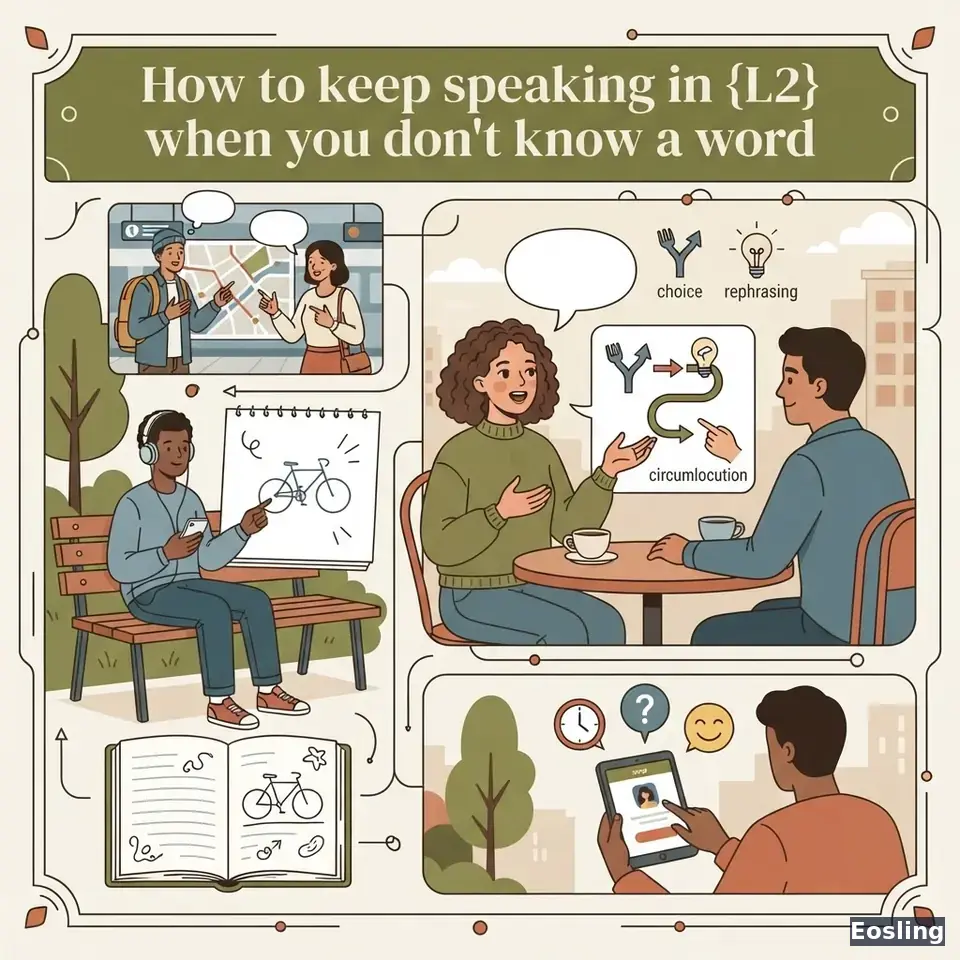
This is the real skill, and it's learnable. Four moves cover almost everything:
- Describe the purpose. Cái này dùng để… (this is used for…) plus a verb gets you shockingly far.
- Compare it to something familiar. Nó giống như… (it's like…) — "it's like a small table" beats silence.
- Give an example. Ví dụ như… (for example…) buys you time and context.
- Ask a short question. Có phải là… không? (is it…?) turns a dead end into teamwork.
And when you genuinely want the word, just ask for it — that's not cheating:
Practising everyday Vietnamese conversation under pressure
Fluency under pressure is a muscle, so train it deliberately. Try these at home, out loud, no dictionary:
Comments
Article discussion: learner comments and Eosling teacher replies
Drop your emotions below — love, debates, even hate welcome. Comment 👇
Don't want to miss my reply? Leave your email — I'll send a copy.