 Turning passive Turkish into active speaking · Aylin · Eosling
Eosling Aylin Blog Turning passive Turkish into active speaking
From Understanding Turkish to Actually Speaking It — Turkish Lessons
Why you can follow Turkish conversations but freeze when it's your turn — learn Turkish online and turn passive understanding into real sentences. Turkish Lessons.
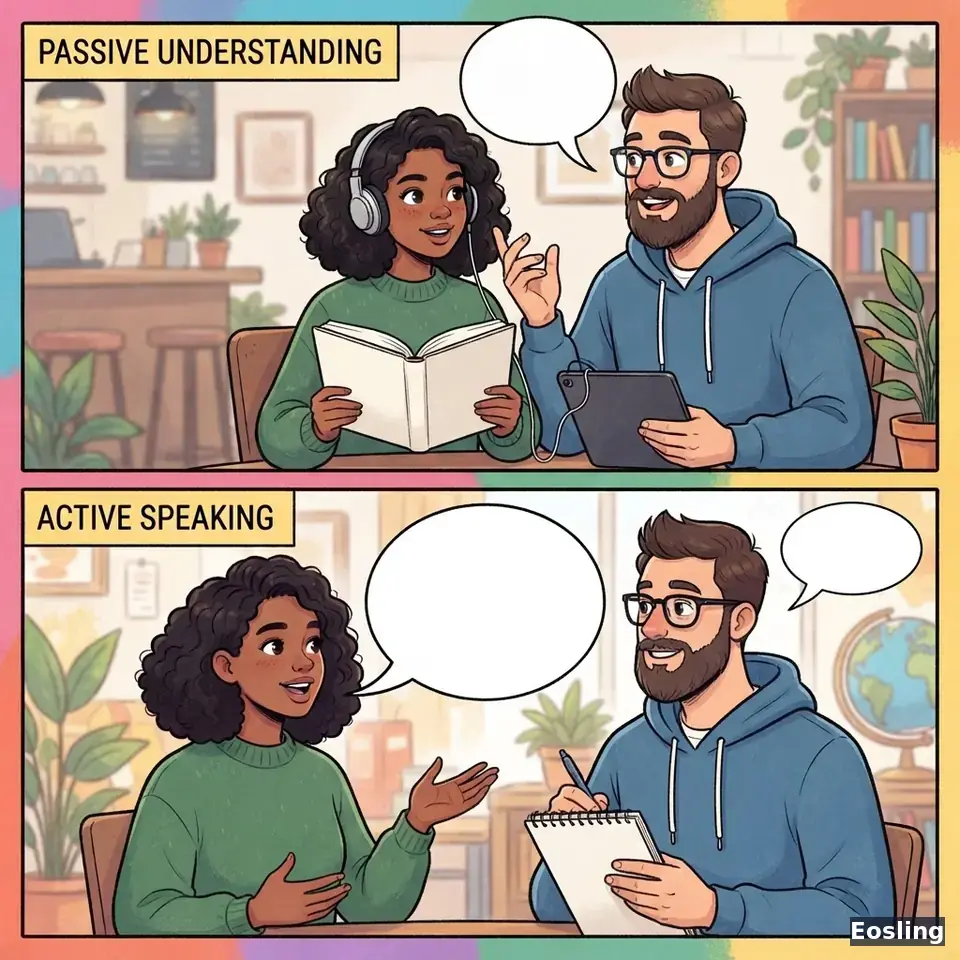
I hear this every week: a student watches a Turkish series without subtitles, nods along to podcasts, reads the news — and then someone asks a simple question and the brain goes blank. If that's you, relax. Understanding and speaking are two different skills, and Turkish makes the gap especially visible. You recognise anlıyorum ama konuşamıyorum perfectly well on the page, yet producing ben de gelmek istiyorum in real time feels like assembling furniture in the dark. If you want to learn Turkish online, the first step is accepting that comprehension and production are trained separately.
Turkish practice
Pronunciation practice
Listen to the phrase, repeat into the mic — your teacher analyzes the audio and gives a real pronunciation score with corrections and comments.
1 / 3
Merhaba, nasılsın?
hello, how are you?
Why you understand but can't speak
Recognition is cheap; production is expensive. When you read yarın görüşürüz, your brain matches a pattern. When you must say it, you have to retrieve the words, pick the right suffix, and order everything — all in under a second. Turkish piles work onto the verb: gelebilirim packs in "come + can + I", and gelmeyebilirdim stacks four ideas into one word. Passive listeners learn to decode these chunks; speakers must build them from scratch. Add the fear of choosing the wrong suffix and the pause becomes a wall.
| English | Turkish | What trips learners |
|---|---|---|
| I understand | anlıyorum | easy to recognise, easy to forget in speech |
| I can come | gelebilirim | ability suffix -ebil- plus person |
| I couldn't come | gelemedim | negative ability, past tense |
| We'll see each other tomorrow | yarın görüşürüz | fixed chunk worth memorising whole |
Turning what you understand into what you say
Stop trying to translate from English. Instead, steal whole phrases and reuse them. Heard çok yorgunum in a show? Say it about yourself tonight. Retell a short message in three simple sentences: arkadaşım aradı, biraz yorgundu, eve gitti. Answer familiar questions out loud — nerelisin, ne iş yapıyorsun, bugün ne yaptın — even alone in the kitchen. Complete sentence beginnings: take bence… or bana göre… and finish them five different ways. None of this is glamorous, but it builds the retrieval path your brain currently lacks.
Comments
Article discussion: learner comments and Eosling teacher replies
Drop your emotions below — love, debates, even hate welcome. Comment 👇
Don't want to miss my reply? Leave your email — I'll send a copy.