 Keeping a Turkish conversation going without the exact w · Aylin · Eosling
Eosling Aylin Blog Keeping a Turkish conversation going without the exact w
How to Keep Talking in Turkish When the Word Just Won't Come — Turkish Lessons
Freezing mid-sentence in Turkish? Learn Turkish online and discover how to describe, simplify and ask your way around a missing word. Turkish Lessons.
Every Turkish learner knows the moment. You're mid-sentence, the other person is nodding, and then the word vanishes. You need "screwdriver" and all you have is bir şey — "a thing." The silence stretches, your cheeks go red, and you quietly switch to English. I've watched students with solid grammar grind to a halt over one missing noun. The trick isn't memorizing more words; it's learning to talk around the gap. If you learn Turkish online, you'll meet this toolbox early: şey ("thing"), gibi ("like"), and the workhorse question ne demek? ("what does it mean?"). Let's put them to work.
Turkish practice
Pronunciation practice
Listen to the phrase, repeat into the mic — your teacher analyzes the audio and gives a real pronunciation score with corrections and comments.
1 / 3
Merhaba, nasılsın?
hello, how are you?
Why we freeze (and why it's mostly in our heads)
Most freezing isn't a language problem — it's a perfectionism problem. We treat the missing word as a wall instead of a detour. The fix is a mental shift: your goal is to be understood, not to produce a flawless sentence. Turkish actually rewards this. The word şey is your safety net — bir şey ("a thing"), öyle bir şey ("something like that"), şey... nasıl diyeyim? ("thing... how should I say it?"). Native speakers use these fillers constantly, so borrowing them makes you sound more natural, not less.
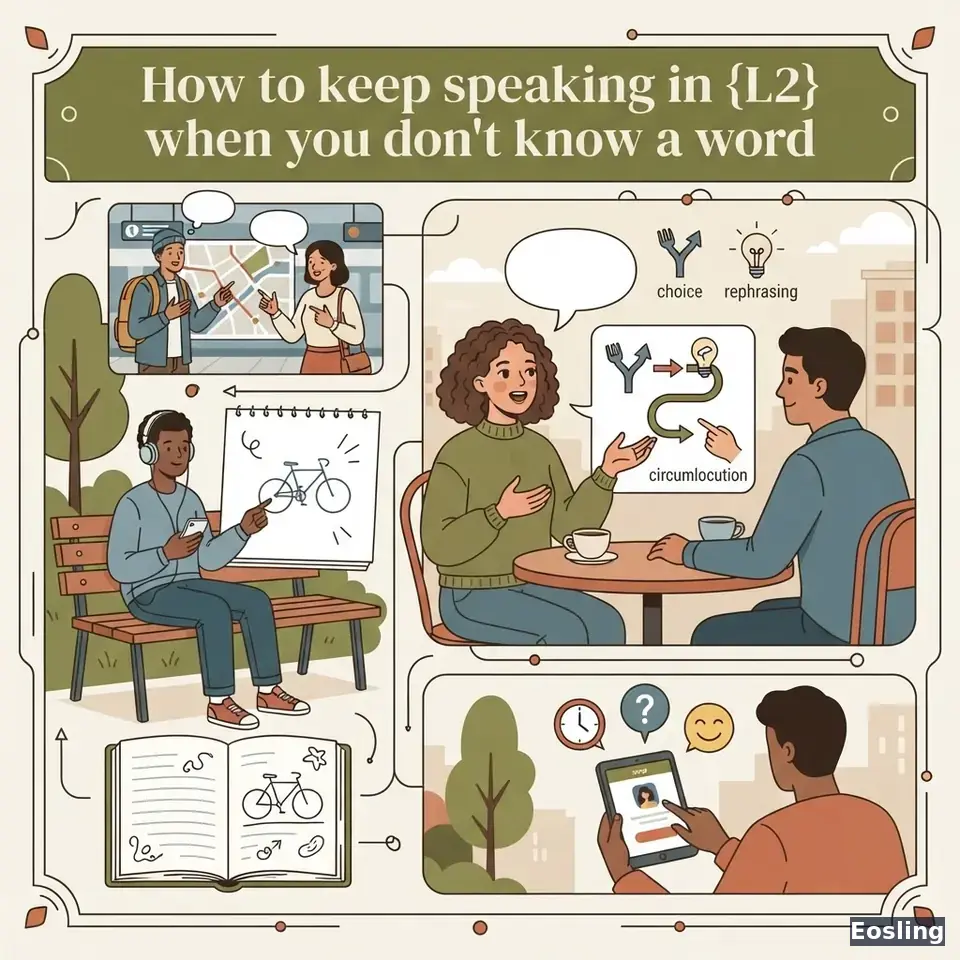
Explain it with the words you already have
You rarely need the exact word — you need the listener to picture it. Describe color, shape, or purpose, give an example, or compare it to something familiar. Here's how the same idea can be rescued in three different ways:
| English | Turkish strategy | Example |
|---|---|---|
| A tool for turning screws | Describe the purpose | Vida sıkmak için bir alet |
| It's like a small knife | Compare | Küçük bir bıçak gibi |
| A thing for the kitchen | Vague + context | Mutfak için bir şey |
Then hand the problem to your listener with a short question: Bunun Türkçesi ne? ("What's this in Turkish?") or Nasıl söylenir? ("How is it said?"). Asking isn't cheating — it's conversation.
Comments
Article discussion: learner comments and Eosling teacher replies
Drop your emotions below — love, debates, even hate welcome. Comment 👇
Don't want to miss my reply? Leave your email — I'll send a copy.