 Aylin · Eosling
How to Stop Translating in Your Head and Start Thinking in Turkish — Learn To Speak Turkish
Why your brain keeps translating before you speak Turkish, when that habit helps, and practical ways to build direct thinking — learn Turkish online with a teacher's guidance. Learn To Speak Turkish.
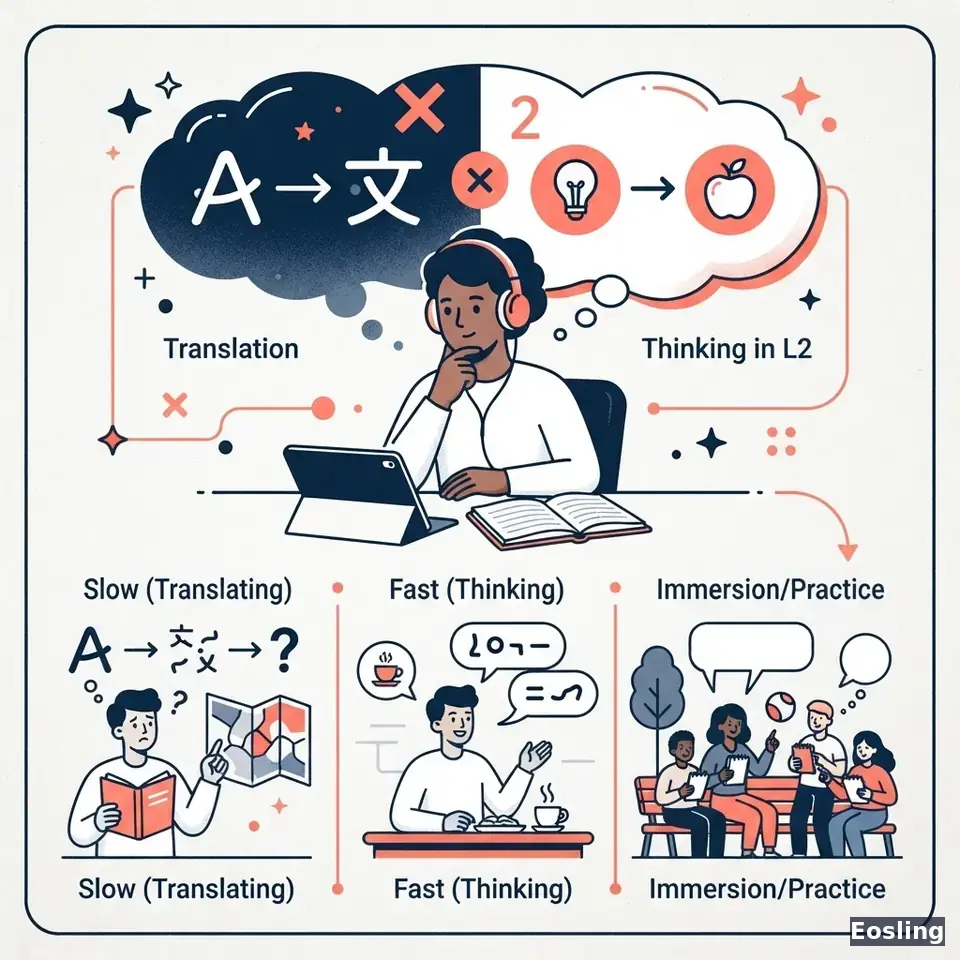
Every Turkish learner I meet apologises for the same thing: "I still build the sentence in English first." They say it like a confession. But here's the honest truth — translating is not a moral failure, it's a stage. The goal isn't to delete English from your brain. It's to stop needing it for every single sentence, so that merhaba, nasılsın? comes out before your inner translator has even cleared its throat. That shift is exactly what it means to learn Turkish online with real purpose — not memorising rules, but training your brain to reach for Turkish first.
Turkish practice
Pronunciation practice
Listen to the phrase, repeat into the mic — your teacher analyzes the audio and gives a real pronunciation score with corrections and comments.
1 / 3
Merhaba, nasılsın?
hello, how are you?
Why your brain keeps translating
Your native language is the fastest retrieval system you own. When you want to say something in Turkish, your brain reaches for the familiar route first — it's efficient, not lazy. For beginners, this is almost unavoidable: you have a small Turkish vocabulary, so you grab the English word and hunt for its Turkish twin.
The trouble is that Turkish doesn't map onto English word by word. English needs "I am going" — three pieces. Turkish packs the same idea into one word: gidiyorum. If you translate piece by piece, you'll produce something that sounds like a puzzle. And as you get more advanced, the habit doesn't vanish on its own — it just gets faster and quieter, until it's the invisible delay before every sentence.
When translation helps, and when it gets in the way
Translation is a genuinely useful learning tool. Looking up a word, checking a grammar point, comparing structures — that's studying, and it works. The problem starts when translation becomes the route to speaking, not the support behind it.
| English | Natural Turkish | Word-by-word trap |
|---|---|---|
| I have a question | Bir sorum var | "I have" ≠ a separate verb here |
| There is no bread | Ekmek yok | yok carries the whole idea |
| I miss you | Seni özledim | literally "I missed you" |
| How old are you? | Kaç yaşındasın? | "how many years are you in" |
Notice the last one: Turkish asks kaç yaşındasın? — "in how many years are you". Translate that literally into English and it sounds absurd; translate English literally into Turkish and you get Nasıl yaşlısın?, which is nonsense. Some phrases simply have to be learned as whole chunks.
Comments
Article discussion: learner comments and Eosling teacher replies
Drop your emotions below — love, debates, even hate welcome. Comment 👇
Don't want to miss my reply? Leave your email — I'll send a copy.