Why You Understand Textbook Polish but Freeze When Someone Actually Talks to You — Speak Polish
Learn Polish online: why native speech sounds like a blur to English speakers, what your English listening habits do to you, and how to train your ears step by step. Speak Polish.
Every learner hits that moment. You've drilled Dzień dobry, jak się masz? and Poproszę kawę until they're automatic. Then a real Pole leans over and says something that sounds like one long word — and your brain quietly leaves the room. I've watched this happen in class a hundred times, and it's not a talent problem. Textbook dialogues are recorded slowly, word by word, by people who want you to succeed. Real speech is made by people who want to finish their sentence. If you want to learn Polish online and actually follow those sentences, the gap between the two is exactly what you have to close.
Polish practice
Pronunciation practice
Listen to the phrase, repeat into the mic — your teacher analyzes the audio and gives a real pronunciation score with corrections and comments.
1 / 3
Cześć, jak się masz?
hello, how are you?
Here's what's actually going on, and how to fix it.
What makes natural Polish hard to catch
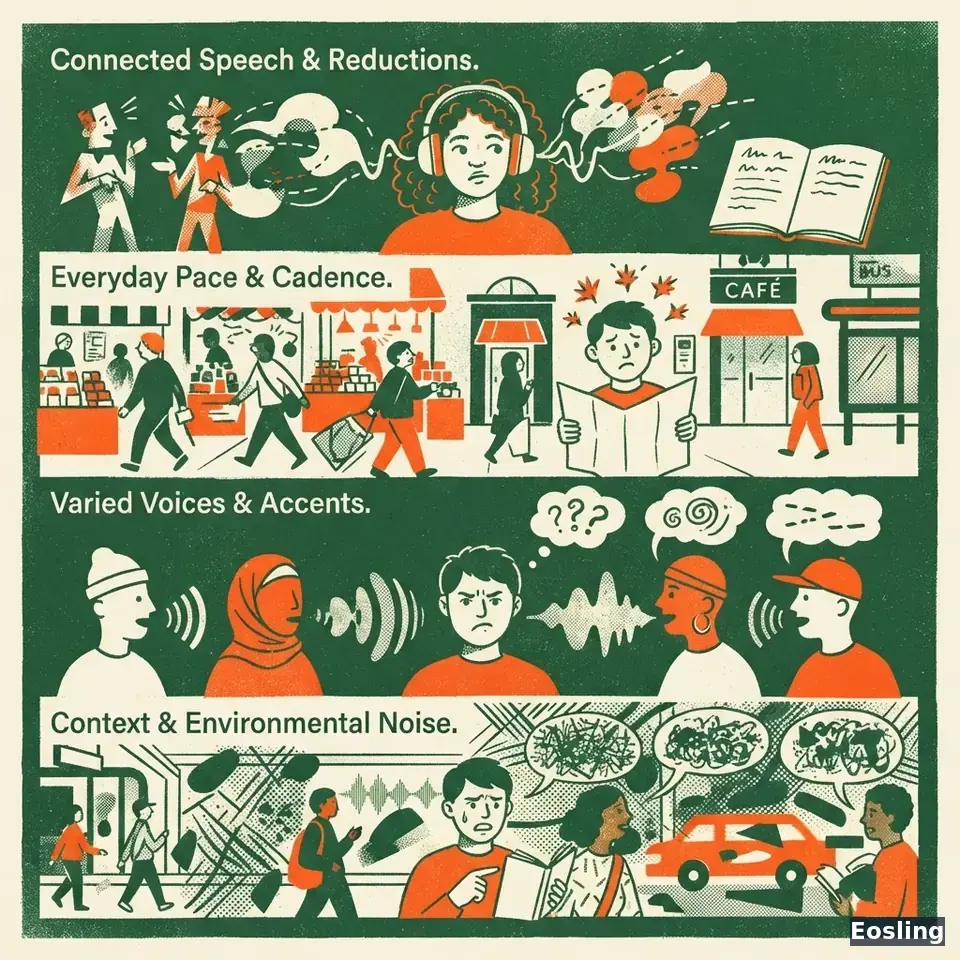
Polish native speech compresses hard. The classic trap is jak się masz turning into something like «jakście masz» in fast, casual talk, or co jest blurring into a single «cojést». Word boundaries dissolve, and endings — which carry so much meaning in Polish — get swallowed. You also get -ś and -m glued onto verbs: zrobiłeś becomes «zrobiłeś», but in speech the ending often rides on the previous word.
Consonant clusters are the other monster. Polish stacks them: wszystko, źdźbło, szczerze. English speakers expect a vowel between hard consonants, so your ear waits for one that never comes.
| English | Polish | Why it's tricky |
|---|---|---|
| everything | wszystko | five consonants, one syllable |
| honestly | szczerze | «szcz» + «rz» clusters |
| I did (masc.) | zrobiłem | final «-łem» often reduced |
| what's up | co jest | blends into one sound |
Your English ears are working against you (gently)
English trained you to hear stress-timed rhythm: strong beats, mushy unstressed syllables. That actually helps — you're used to reductions. But English never asks you to process rz vs ż or ś vs sz as meaning-changing sounds, and Polish does constantly. Your brain files them as "background noise" until you teach it otherwise. You also expect stress on the first syllable (English often does), which mostly works in Polish — but it can make you miss emphatic shifts.
Comments
Article discussion: learner comments and Eosling teacher replies
Drop your emotions below — love, debates, even hate welcome. Comment 👇
Don't want to miss my reply? Leave your email — I'll send a copy.