How to Stop Translating in Your Head and Start Thinking in Polish — Learn To Speak Polish
Learn Polish online: why your brain keeps translating, when it helps, and practical exercises to build direct thinking in Polish. Learn To Speak Polish.
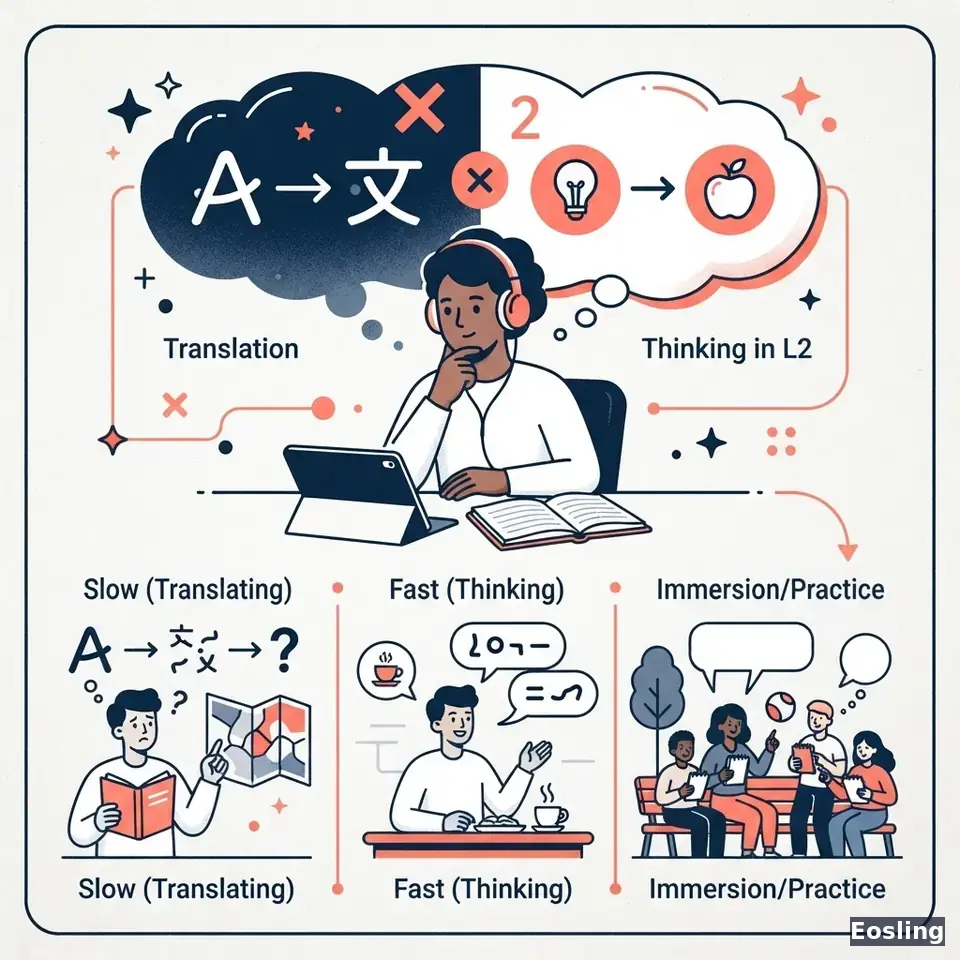
Every English speaker who learns Polish hits the same wall. You want to say something simple — "I need coffee" — and instead of reaching for potrzebuję kawy, your brain runs the whole English sentence first, then swaps words one by one. The result is slow, clunky, and often wrong. I see it in my lessons constantly, and honestly, it's not a flaw. It's just a stage. If you learn Polish online, you'll meet this stage sooner or later — everyone does.
Polish practice
Pronunciation practice
Listen to the phrase, repeat into the mic — your teacher analyzes the audio and gives a real pronunciation score with corrections and comments.
1 / 3
Cześć, jak się masz?
hello, how are you?
The good news: you don't have to kill your inner translator. You just have to stop letting it drive every sentence. Let's look at why it happens, when to lean on it, and how to loosen its grip.
Why does the brain keep translating? — Everyday Polish conversation
Your native language is a well-worn highway. When you speak English, words arrive automatically. Polish, at first, is a dirt path — you have to consciously walk it. So your brain takes the shortcut: grab the English meaning, then hunt for Polish equivalents.
This is especially strong with Polish because the grammar asks so much of you. You can't just swap words; you have to decide case, gender, and verb form. Saying Mam kota ("I have a cat") requires knowing kot takes the accusative here. If you translate word-by-word from "I have a cat," you may freeze on kota versus kot. The translation habit isn't laziness — it's your brain buying time to run the grammar checks.
Automaticity comes with repetition, not willpower. The more often you retrieve potrzebuję directly, the less you'll reach for "I need" first.
When translation helps — and when it gets in the way
Translation is a genuinely useful learning tool, especially early on. Looking up jutro for "tomorrow" and connecting it to a mental image is smart. Beginners should lean on their English to make sense of Polish structures.
The problem is when translation becomes the default for every sentence in everyday Polish conversation. Then it slows you down and produces unnatural Polish. A few English-to-Polish traps:
| English habit | Natural Polish | Why translating fails |
|---|---|---|
| "I am cold" | Jest mi zimno | Literally "it is cold to me" — no "I am" |
| "I have 25 years" | Mam 25 lat | Polish uses mieć (have), not "be" |
| "I like coffee" | Lubię kawę | Not "kawa mi się podoba" for taste |
Notice Jest mi zimno — if you translate "I am cold" word by word, you'll produce something Poles won't recognise. The dative mi is doing quiet work that English hides.
Comments
Article discussion: learner comments and Eosling teacher replies
Drop your emotions below — love, debates, even hate welcome. Comment 👇
Don't want to miss my reply? Leave your email — I'll send a copy.