Eosling Zosia Blog Surviving Polish conversations without the right word
How to Keep Talking in Polish When the Word Just Won't Come — Polish Lessons
Learn Polish online with practical strategies for keeping a conversation alive when you forget a word — describing, paraphrasing, and asking for help. Polish Lessons.
Every Polish learner knows the moment: you're mid-sentence, the perfect word is right there on the tip of your tongue, and then — silence. I've watched students freeze over something as simple as
Polish practice
Pronunciation practice
Listen to the phrase, repeat into the mic — your teacher analyzes the audio and gives a real pronunciation score with corrections and comments.
1 / 3
Cześć, jak się masz?
hello, how are you?
Why do we freeze in the first place? — Everyday Polish conversation
Most of the panic isn't about Polish itself — it's about the story we tell ourselves. We decide that if we can't produce the exact noun, the whole sentence is worthless, so we abandon it. Polish makes this worse in a specific way: the grammar is so tightly built that a missing word can feel like a broken machine. You want to say «I need to buy a screwdriver», reach for śrubokręt, come up empty, and suddenly you're not sure whether it's kupić or kupować, and the sentence collapses under its own weight.
There's also the fear of a case ending going wrong in front of a native speaker. But honestly? If you say Potrzebuję coś do… and trail off, no Polish person is grading your declension. They're waiting to find out what you need. The freeze is internal, not external.
How to explain an idea with the words you already have
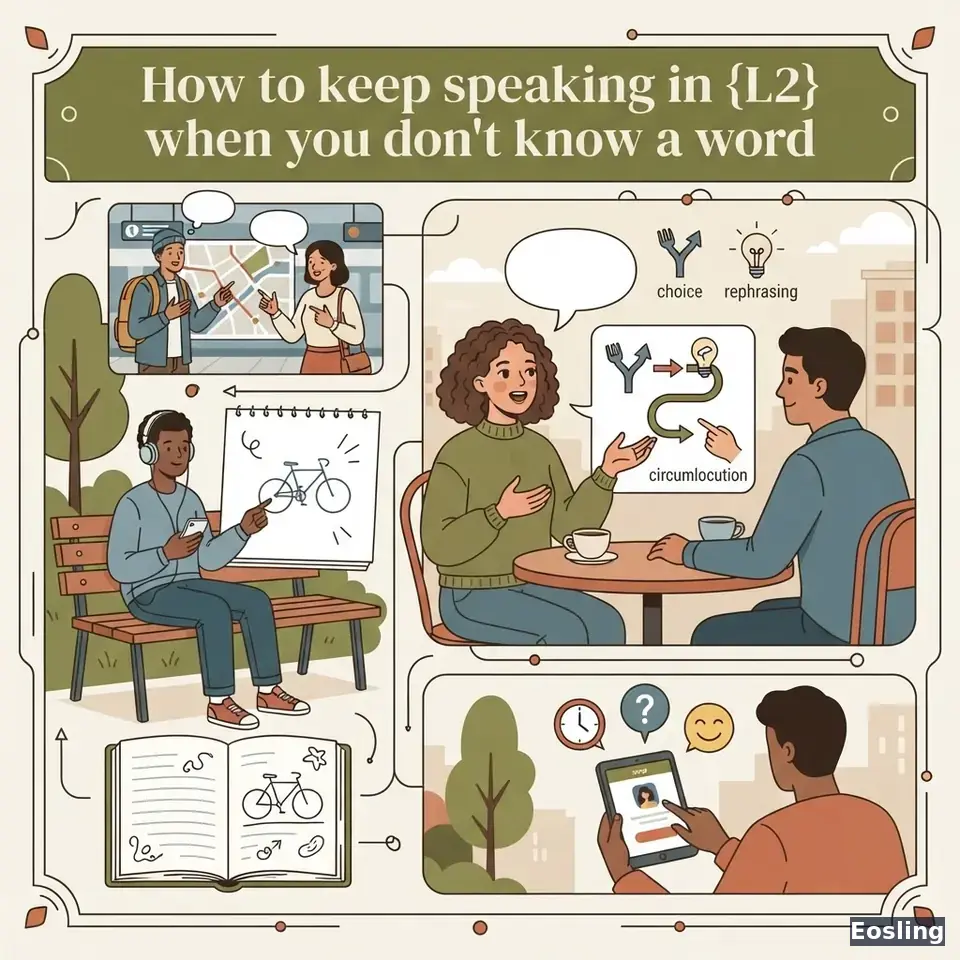
This is where the real skill lives, and it's the heart of everyday Polish conversation. When the exact word is gone, describe around it. Talk about what the thing looks like, what it's for, or what it's similar to. A screwdriver becomes coś, czym się kręci śruby — "something you turn screws with". A corkscrew is to, co otwiera wino. You don't need the noun; you need the function.
| English strategy | Polish phrase to reach for |
|---|---|
| Describing purpose | To jest do… (this is for…) |
| Comparing to something familiar | To jest podobne do… (it's similar to…) |
| Giving an example | Na przykład… (for example…) |
| Asking for the word | Jak to się mówi po polsku? (how do you say this in Polish?) |
| Buying time | No więc… jak to powiedzieć… (well… how to put it…) |
To jest do otwierania puszek — this is for opening cans. Jak to się nazywa? — what is this called? These two phrases alone will save you a dozen conversations.
Comments
Article discussion: learner comments and Eosling teacher replies
Drop your emotions below — love, debates, even hate welcome. Comment 👇
Don't want to miss my reply? Leave your email — I'll send a copy.