 Passive Japanese to active speaking · Yuki · Eosling
Eosling Yuki Blog Passive Japanese to active speaking
From Understanding to Speaking Japanese: A Practical Bridge — Japanese Lessons
You understand a lot of Japanese but freeze when it's your turn to talk. Learn Japanese online and move from passive listening to real sentences. Japanese Lessons.
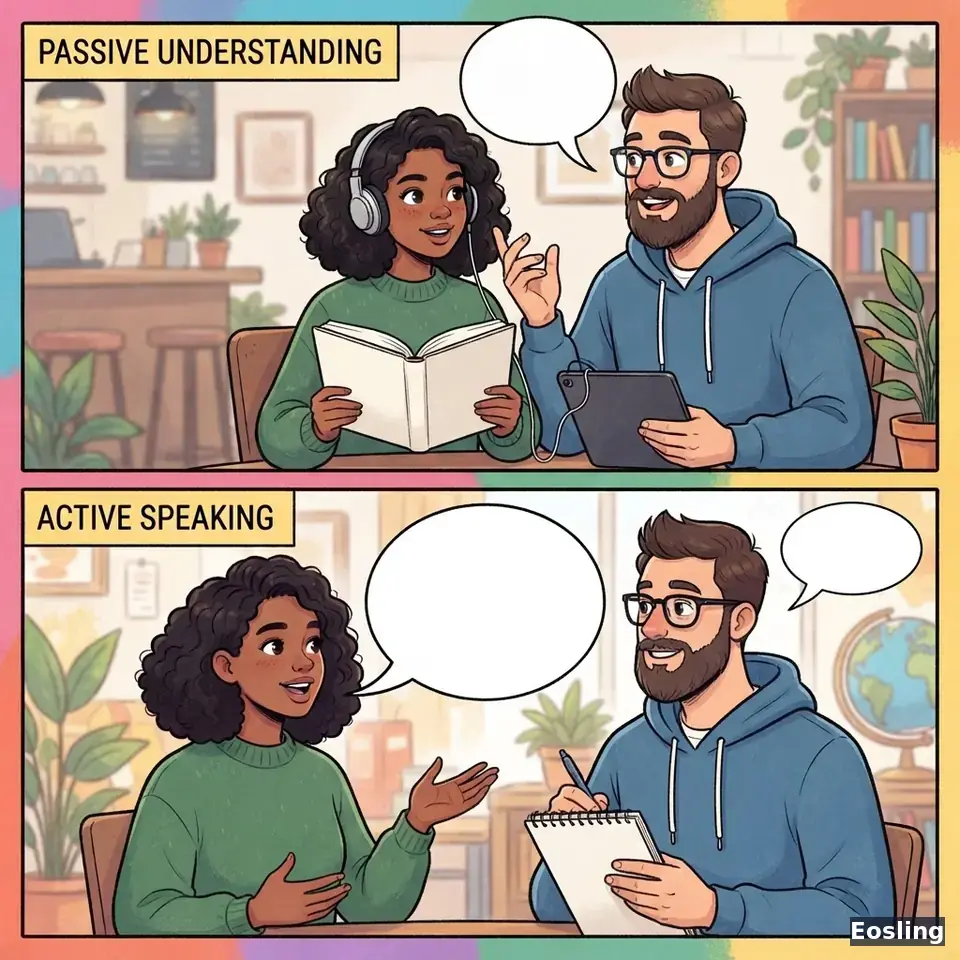
Students come to me all the time with the same confession: they can follow an anime episode, read a simple article, nod along to a podcast — and then someone asks them a question and their mind goes blank. "I understood everything," they say,
Japanese practice
Pronunciation practice
Listen to the phrase, repeat into the mic — your teacher analyzes the audio and gives a real pronunciation score with corrections and comments.
1 / 3
こんにちは、元気ですか?
konnichiwa, genki desu ka?
hello, how are you?
Why you understand but freeze when speaking — Speak Japanese like a local
Recognition is a matching game. You hear たべました and your brain finds the meaning instantly — the sound is a key, the meaning is a lock. Production is the reverse: you have a meaning and must build the key from scratch, choosing the verb, the tense, the politeness level, the particle order. That's why たべました ("I ate") feels easy to hear and hard to say. Your vocabulary is stored as recognition, not as retrieval — like recognizing a face but forgetting the name.
There's also the fear factor. English lets you stall with "um" and "well." Japanese has its own fillers — ええと, そうですね — but learners often feel they must produce a perfect sentence instantly. Add the time pressure of a real conversation and the whole system jams. Mistakes aren't a sign you failed; they're the sound of a system under construction.
Turning what you understand into what you can say
The trick is to stop treating comprehension as the finish line and start converting it into output. Take a phrase you already recognize and rebuild it yourself:
| English | Japanese you can say | What you're practicing |
|---|---|---|
| I understand | わかります | present polite form |
| I understood | わかりました | past polite form |
| I don't understand | わかりません | negative form |
| Please say it again | もう一度お願いします | a survival phrase |
Say each one out loud, not just once — five times, until your mouth knows it. Then retell something short in your own simple words: you watched a scene where someone ate, so say たべました. You read that a place is a school, so say がっこうです. Answer familiar questions aloud even when no one is listening: お名前は? — ユキです. Complete sentence beginnings I give you: きょうは… and you finish with あついです. Reuse phrases you heard in a conversation, even clumsily. Every reused phrase is a retrieval rep.
Comments
Article discussion: learner comments and Eosling teacher replies
Drop your emotions below — love, debates, even hate welcome. Comment 👇
Don't want to miss my reply? Leave your email — I'll send a copy.