 Yuki · Eosling
How to Stop Translating in Your Head and Start Thinking in Japanese — Learn To Speak Japanese
Why your brain keeps routing Japanese through English, when translation helps, and practical drills to build direct thinking. Learn Japanese online with clear, friendly guidance. Learn To Speak Japanese.
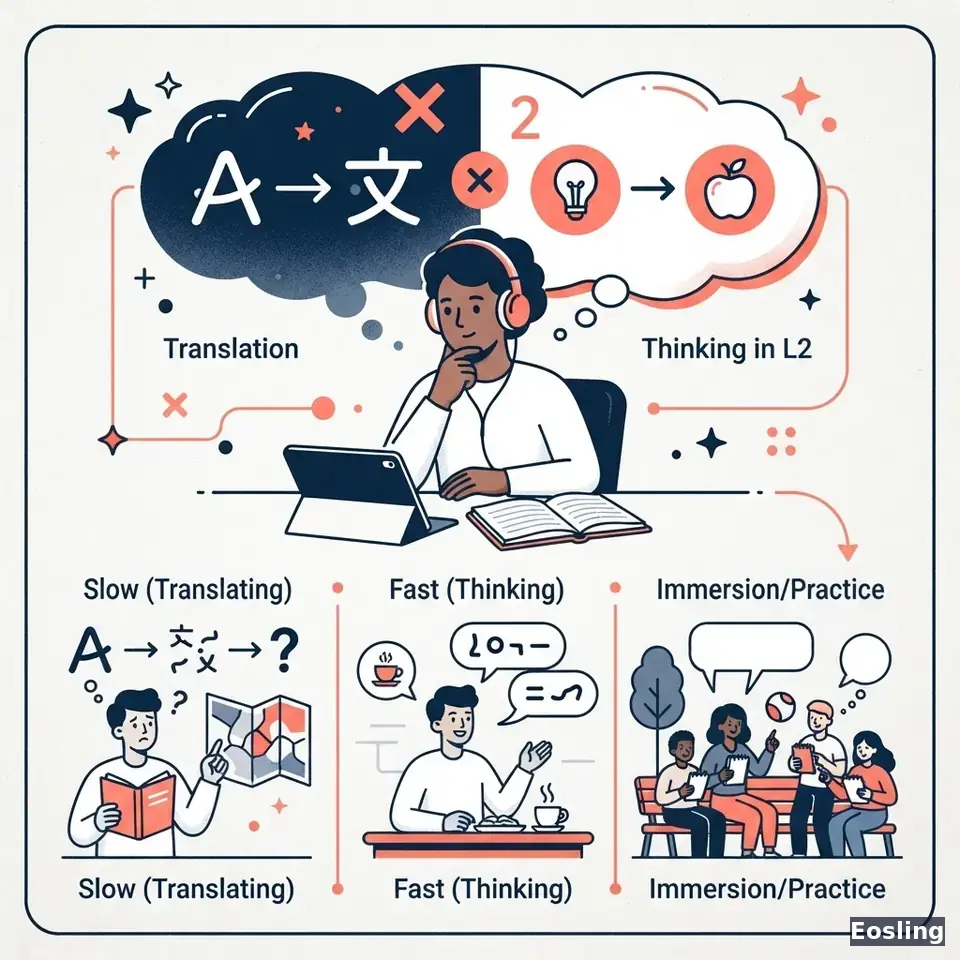
Every learner knows the pause: you want to say something simple, and your brain runs a tiny translation office — English in, Japanese out, with a queue. I did the same thing when I learned English, mentally conjugating before every sentence. So when a student tells me Nihongo de hanasu no wa muzukashii because they keep drafting in English first, I nod. That pause is not a flaw; it is your brain being efficient with what it already owns. If you want to learn Japanese online, the first realistic goal is not to delete English from your head but to shrink the queue, so that shiroi neko ga iru eventually arrives without a detour through "there is a white cat."
Japanese practice
Pronunciation practice
Listen to the phrase, repeat into the mic — your teacher analyzes the audio and gives a real pronunciation score with corrections and comments.
1 / 3
こんにちは、元気ですか?
konnichiwa, genki desu ka?
hello, how are you?
Why does your brain keep translating? — Everyday Japanese conversation
Translation is a retrieval shortcut. Your native language has thousands of ready-made chunks; Japanese has a growing but smaller set. Under time pressure, the brain grabs the fast route. It also has to do more work in Japanese than in English: word order flips (verb last), particles mark roles, and politeness is baked into verb endings. That is a lot to assemble while also deciding what you mean.
Automaticity is the real fix, and it comes from repetition, not willpower. Beginners translate more because every form is still conscious. As tabemasu and tabeta and tabete imasu become one familiar shape rather than three puzzles, the detour gets shorter on its own. This is also why steady practice matters more than occasional bursts: the more you use Japanese in real situations, the less your brain needs to route everything through English first.
When translation helps — and when it gets in the way
Translation is a legitimate study tool. For tricky grammar, checking meaning, or reading above your level, English is a useful scaffold. It gets in the way when you use it for every sentence in real conversation, because you are doing two jobs at once and the second one is slow.
| English | Natural Japanese | The trap |
|---|---|---|
| I like sushi | sushi ga suki desu | "I like" tempts you to start with watashi wa and hunt for a verb meaning "like" |
| Please sit down | suwatte kudasai | English puts "please" first; Japanese puts the request after the verb |
| I don't have time | jikan ga arimasen | Literal "I don't have" becomes motte imasen, which sounds like not physically holding something |
| Can you speak English? | eigo ga hanasemasu ka | English uses "can you"; Japanese prefers the potential form of the verb |
Comments
Article discussion: learner comments and Eosling teacher replies
Drop your emotions below — love, debates, even hate welcome. Comment 👇
Don't want to miss my reply? Leave your email — I'll send a copy.