 Keeping Japanese conversation flowing without exact word · Yuki · Eosling
Eosling Yuki Blog Keeping Japanese conversation flowing without exact word
How to Keep Speaking Japanese When You Don't Know the Word — Japanese Lessons
Learn Japanese online with practical strategies for staying in a conversation when a word escapes you — describe, simplify, and ask your way through instead of freezing up. Japanese Lessons.
Every learner hits that moment: you're mid-sentence in Japanese, the conversation is rolling, and suddenly the one noun you need is gone. You know it starts with a "k" sound. You can almost see the object. And your mouth just stops. I've watched students turn a friendly chat into a silent stare at the table because they couldn't retrieve a single word. Here's the thing I tell them: you don't need the perfect word to keep going. You need ちょっと待って ("hold on a sec"), こういう ("this kind of thing"), and the courage to talk around the gap instead of apologising for it — the same instinct you build when you learn Japanese online and practise real conversation, not just flashcards.
Japanese practice
Pronunciation practice
Listen to the phrase, repeat into the mic — your teacher analyzes the audio and gives a real pronunciation score with corrections and comments.
1 / 3
こんにちは、元気ですか?
konnichiwa, genki desu ka?
hello, how are you?
Why we freeze (and why it's mostly in our heads) — Everyday Japanese conversation
The freeze usually isn't a vocabulary problem — it's a focus problem. You've decided that this one word is the only acceptable way to finish the sentence, so the whole sentence hangs on it. Add the fear of getting the particle wrong, and the brain treats the pause like a failure instead of a normal part of talking.
Japanese makes this worse in a sneaky way, because the verb comes at the end. English speakers are used to front-loading the key noun; in Japanese you can often buy time with the structure itself. Compare:
| English habit | Japanese rescue move | What it buys you |
|---|---|---|
| "I need the… the… thing" | あの、それで、えっと… | Natural filler, not silence |
| Naming the object immediately | 丸いやつ ("the round one") | Describes instead of labels |
| Restarting the sentence | ちょっと違う言い方すると ("put another way") | A clean re-entry |
The fillers aren't embarrassing — native speakers use えっと and あの constantly. What sounds odd is a learner going completely silent, then apologising in English.
Talking around the word you lost
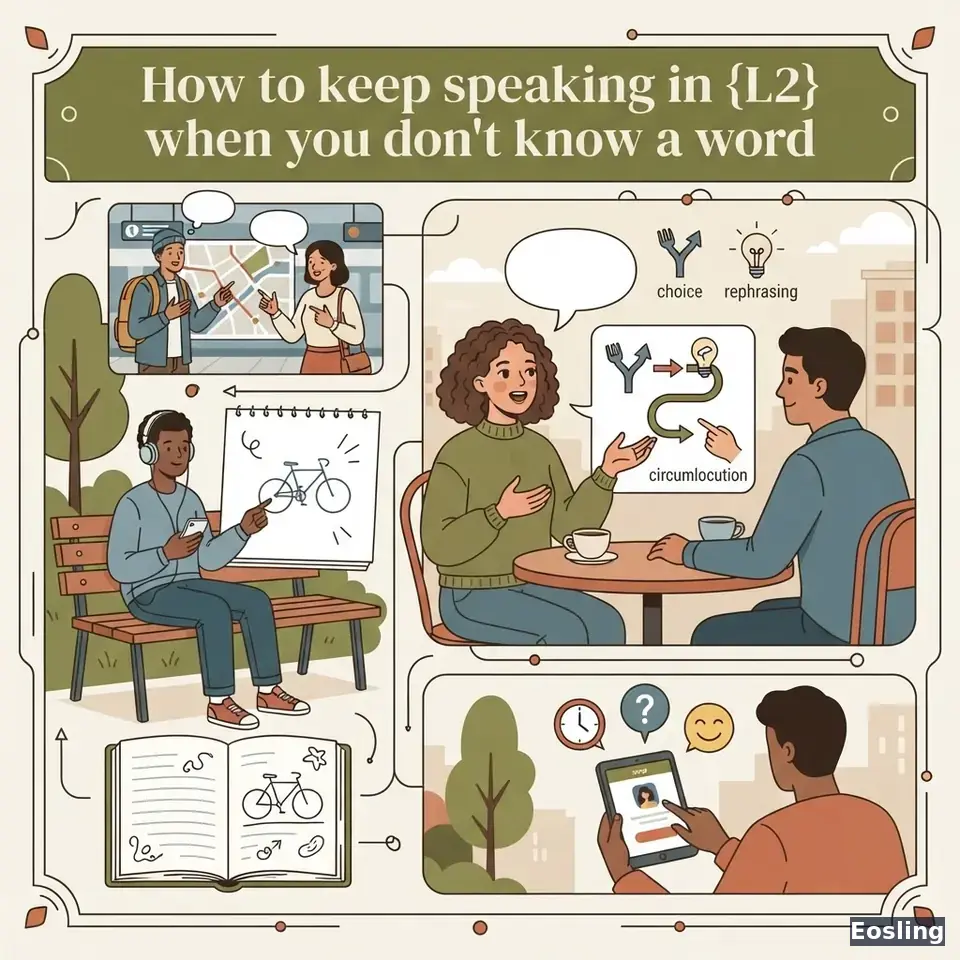
The core skill is describing purpose, shape, or category using words you already own. If you forget "scissors," you don't need to look it up mid-conversation — you can say
Two more moves worth drilling:
- Simpler synonym: swap a rare verb for a common one. Instead of hunting for a precise verb, use 作る ("make") or やる ("do") and let context carry it.
- Short clarification question: 何て言うか忘れました("I forgot how to say it") orそれ、どういう意味ですか("what does that mean?") keeps the other person helping instead of guessing.
Comments
Article discussion: learner comments and Eosling teacher replies
Drop your emotions below — love, debates, even hate welcome. Comment 👇
Don't want to miss my reply? Leave your email — I'll send a copy.