 Turning passive Italian understanding into active speaki · Giulia · Eosling
Eosling Giulia Blog Turning passive Italian understanding into active speaki
From Understanding Italian to Actually Speaking It — Italian Lessons
Why you can follow Italian conversations but freeze when it's your turn to talk — learn Italian online and move from passive understanding to real speech. Italian Lessons.
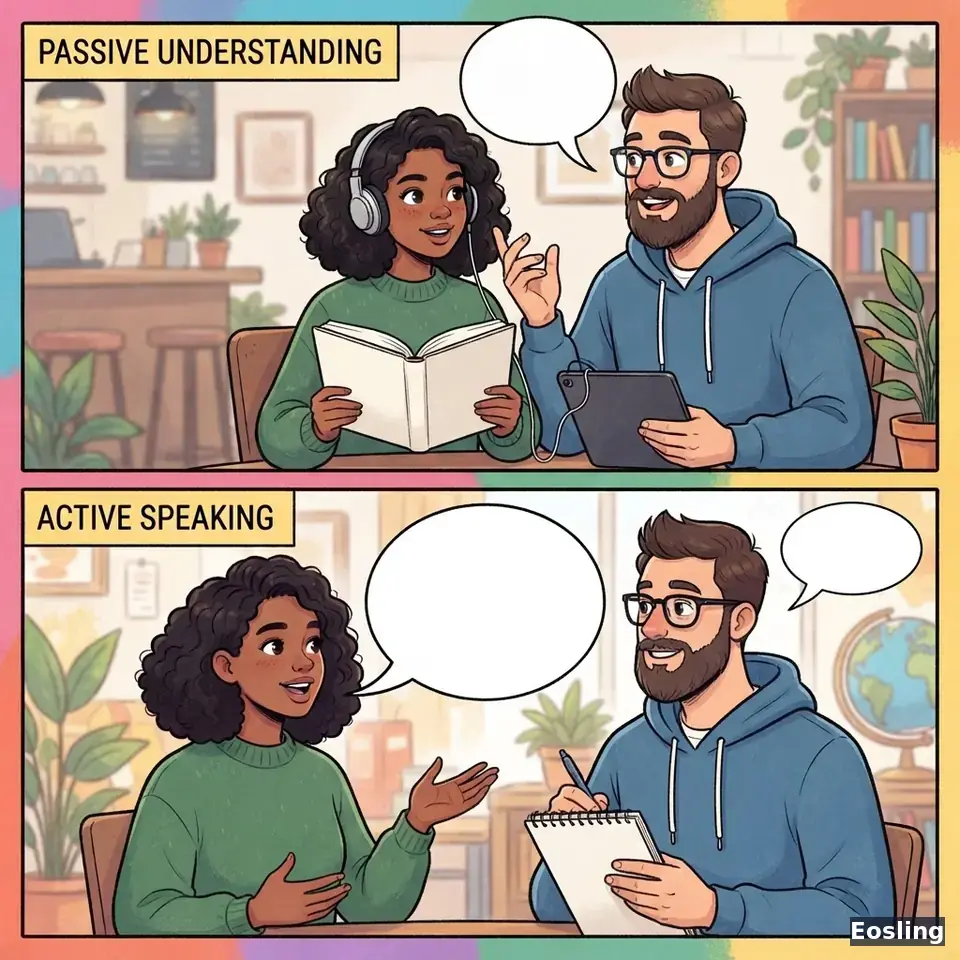
Every week a student tells me the same thing: "I understand everything you say, Giulia, but when I open my mouth, nothing comes out." It's one of the most common and most frustrating walls in language learning — and it's exactly why so many people decide to learn Italian online and then stall at the same point. You can follow a podcast, read a menu, nod along to come stai? — yet producing your own
Italian practice
Pronunciation practice
Listen to the phrase, repeat into the mic — your teacher analyzes the audio and gives a real pronunciation score with corrections and comments.
1 / 3
Ciao, come stai?
hello, how are you?
Why you understand Italian but can't speak it — Everyday Italian conversation
Understanding and speaking are two different skills that live in different parts of your brain. Recognition is fast and forgiving: you hear ho mangiato and the meaning just lands. Production is slow and demanding: you have to retrieve the right word, assemble the grammar, and pronounce it, all before the other person loses patience. That gap has a name — passive versus active knowledge — and it's completely normal.
Think about parlo versus capisco. You've heard capisco a thousand times, so it's ready. But parlo requires you to choose a subject, pick the right ending, and commit out loud. Add fear of a wrong ending and the sentence dies in your throat. Also, Italian verbs change constantly: sono andato versus sono andata, ho parlato versus parlavo. Your brain is doing real work, and it needs time.
How to turn what you understand into something you can say
The trick is to stop trying to create sentences from scratch and start reusing chunks you already recognise. Build a small stock of ready-made phrases and say them until they're automatic — this is the core of everyday Italian conversation, and it's where most of the progress happens.
| English | Italian chunk to reuse |
|---|---|
| I would like… | Vorrei… |
| I think that… | Penso che… |
| Can you repeat? | Puoi ripetere? |
| It seems to me that… | Mi sembra che… |
Vorrei un bicchiere d'acqua, per favore.
Penso che sia una buona idea.
Then try retelling. Listen to a short clip, then summarise it in three simple sentences using only words you're sure of. If the original says
Comments
Article discussion: learner comments and Eosling teacher replies
Drop your emotions below — love, debates, even hate welcome. Comment 👇
Don't want to miss my reply? Leave your email — I'll send a copy.