Giulia Blog Italian vs Your Native Language: What Comes Easy, What Fights Back
Italian vs Your Native Language: What Comes Easy, What Fights Back
An honest look at learning Italian from English — where cognates and familiar grammar help you, and where articles, double consonants and the congiuntivo will make you sweat.
Every week a student tells me, half proud and half suspicious: «This is basically English with extra vowels, right?» And every week I have to break the news gently. Yes, la musica and il problema feel like old friends, and la situazione practically introduces itself. But then the same student tries to say «I hope you come» and freezes somewhere between spero che tu venga and a small existential crisis. Italian is not hard — it is just specific. Let me show you where English speakers glide and where they trip.
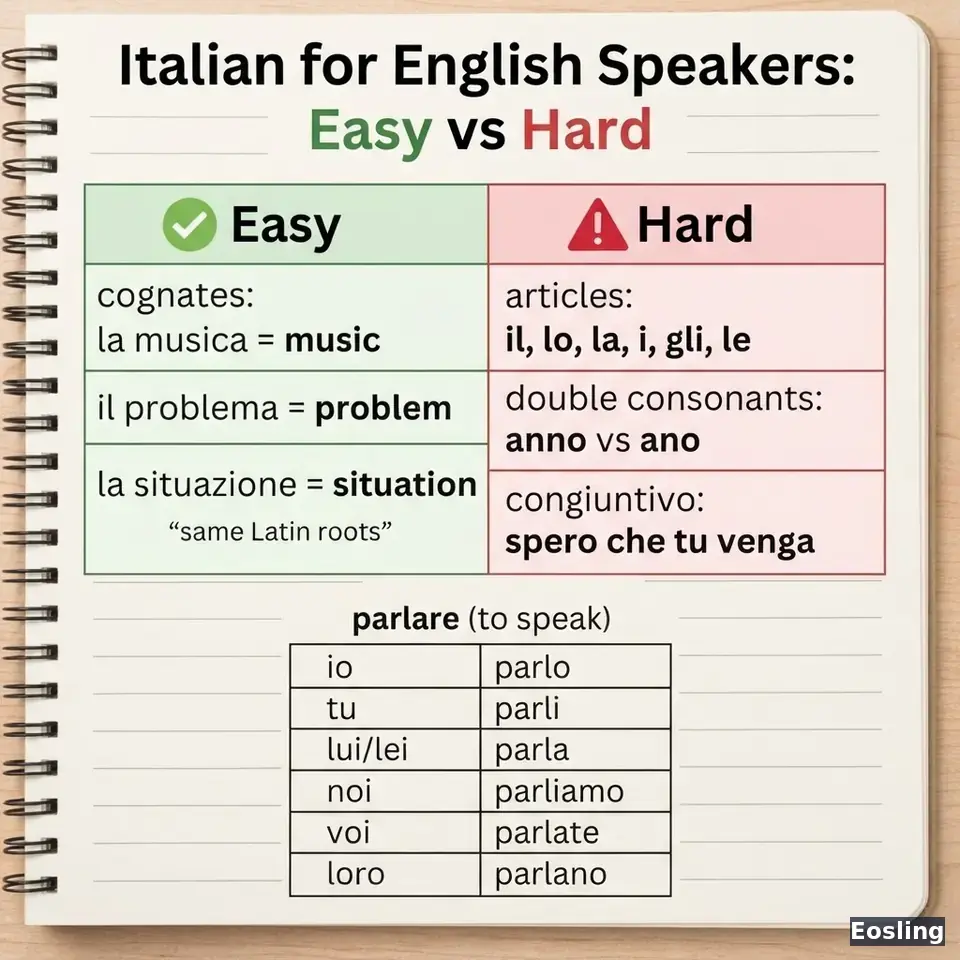
The easy part: you already know more than you think
English and Italian share a huge Latin-derived vocabulary, and once you spot the patterns, your brain starts auto-completing. The trick is the ending: English words often map to an Italian word with -zione, -ità or -mente attached.
| English | Italian | Trap? |
|---|---|---|
| situation | la situazione | none — safe |
| university | l'università | safe |
| important | importante | safe |
| actually | attualmente | yes! means «currently» |
| parent | il parente | yes! means «relative» |
That last pair is the classic falso amico — a false friend. Attualmente does not mean «actually», and il parente is not your mum. Learn these in pairs and they stop biting.
Pronunciation is another gift: Italian is spelled the way it sounds, and vowels are pure and short. Say
The hard part: articles, doubles and the dreaded congiuntivo
Here is where English speakers pay their tuition. Italian nouns drag an article around like a suitcase, and the article changes with gender, number and even the first letter of the next word: il libro, lo studente, la casa, i libri, gli studenti, le case. There is no shortcut — only exposure.
Double consonants are worse than they look. Anno (year) and ano (a completely different word) are separated by one held breath, and Italians hear the difference instantly. Same with pala and palla, casa and cassa. My advice: exaggerate the doubles in practice until your mouth believes them.
And then there is the congiuntivo — the subjunctive. English mostly dropped it; Italian guards it jealously. After expressions of doubt, hope or opinion, you need it:
Comments
Article discussion: learner comments and Eosling teacher replies
Drop your emotions below — love, debates, even hate welcome. Comment 👇
Don't want to miss my reply? Leave your email — I'll send a copy.