 Keeping Italian conversation going without the exact wor · Giulia · Eosling
Eosling Giulia Blog Keeping Italian conversation going without the exact wor
How to Keep Speaking Italian When You Don't Know the Word — Italian Lessons
Learn Italian online: practical strategies to keep your Italian conversation alive when a word escapes you — describe, simplify, and ask for help without freezing up. Italian Lessons.
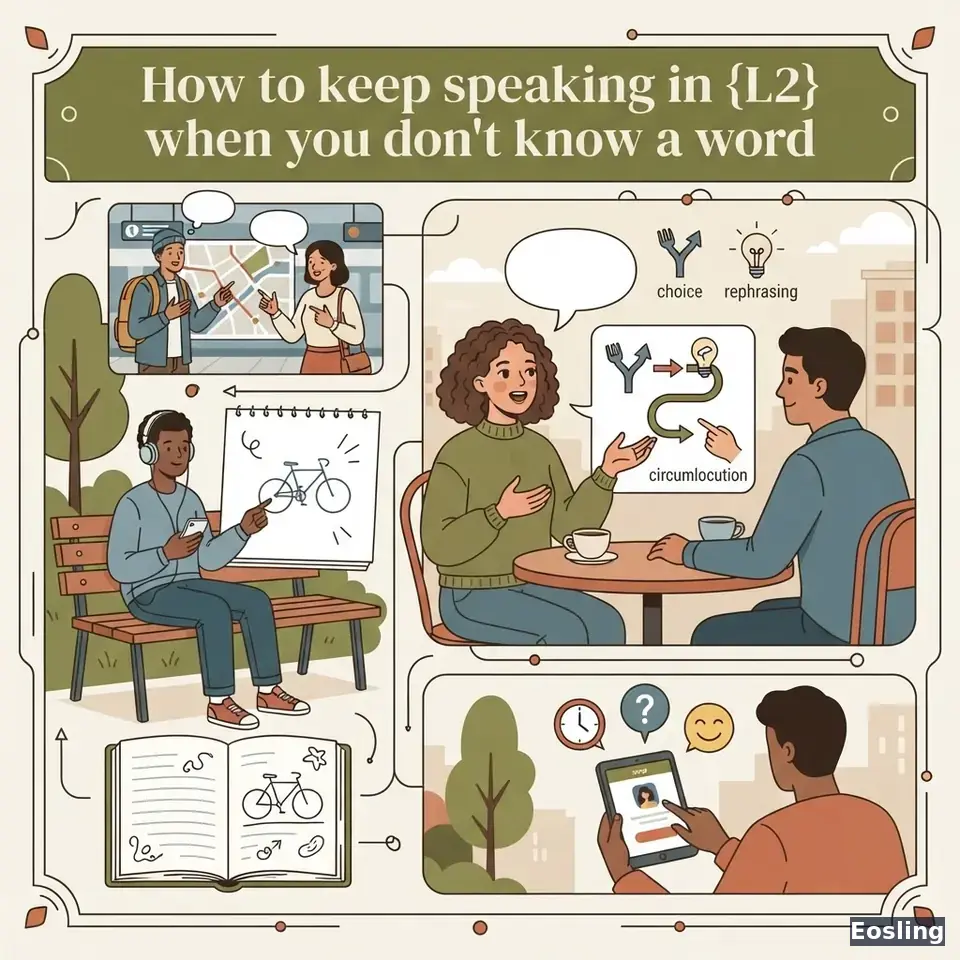
Every Italian learner knows the moment: you're mid-sentence, the next word is right there on the tip of your tongue, and suddenly your brain sounds like a scratched record. I've watched students freeze over the simplest things — come si dice…? — and then apologise for existing. Here's the thing I tell them every week: communication is not a vocabulary test. You don't need the perfect word to be understood. You need a few tricks and the courage to keep the sentence moving. That is exactly what you practise when you learn Italian online — not memorising lists, but keeping the sentence alive. So let's talk about come spiegare una parola che non ricordi — how to explain a word you've forgotten — without reaching for your phone.
Italian practice
Pronunciation practice
Listen to the phrase, repeat into the mic — your teacher analyzes the audio and gives a real pronunciation score with corrections and comments.
1 / 3
Ciao, come stai?
hello, how are you?
Why do we freeze in the first place? — Speak Italian like a local
Most learners freeze because they're hunting for one exact word, as if the sentence is a locked door and only that key will open it. But Italian gives you plenty of other doors. The real problem is the fear of sounding silly — and honestly, Italians are far more forgiving of a clumsy sentence than of silence. If you can't recall il cavatappi (the corkscrew), don't panic. Say what it does instead:
Explain it with the words you already have
The trick is to describe, not to translate. Talk about what the object looks like, what it's for, or what it reminds you of. These phrases are your safety net:
| English | Italian phrase |
|---|---|
| It's a thing that serves to… | È una cosa che serve per… |
| That thing you use for… | Quella cosa che si usa per… |
| It's like a… but smaller | È come un… ma più piccolo |
| That is to say… | Cioè… |
| How do you say…? | Come si dice…? |
Quella cosa che si usa per…
Notice that cioè ("that is to say") is a gift — it lets you rephrase on the spot without stopping. And come si dice…? is not a confession of failure; it's a normal question that even native speakers ask. Use it. This is the core of everyday Italian conversation: you work with the words you have, not the ones you wish you had.
Comments
Article discussion: learner comments and Eosling teacher replies
Drop your emotions below — love, debates, even hate welcome. Comment 👇
Don't want to miss my reply? Leave your email — I'll send a copy.