 Bridging passive Indonesian comprehension to active spea · Dewi · Eosling
Eosling Dewi Blog Bridging passive Indonesian comprehension to active spea
From Understanding to Speaking Indonesian: Your First Real Sentences — Indonesian Lessons
You understand Indonesian but freeze when it's your turn to talk. Learn Indonesian online and bridge the gap from passive comprehension to real sentences. Indonesian Lessons.
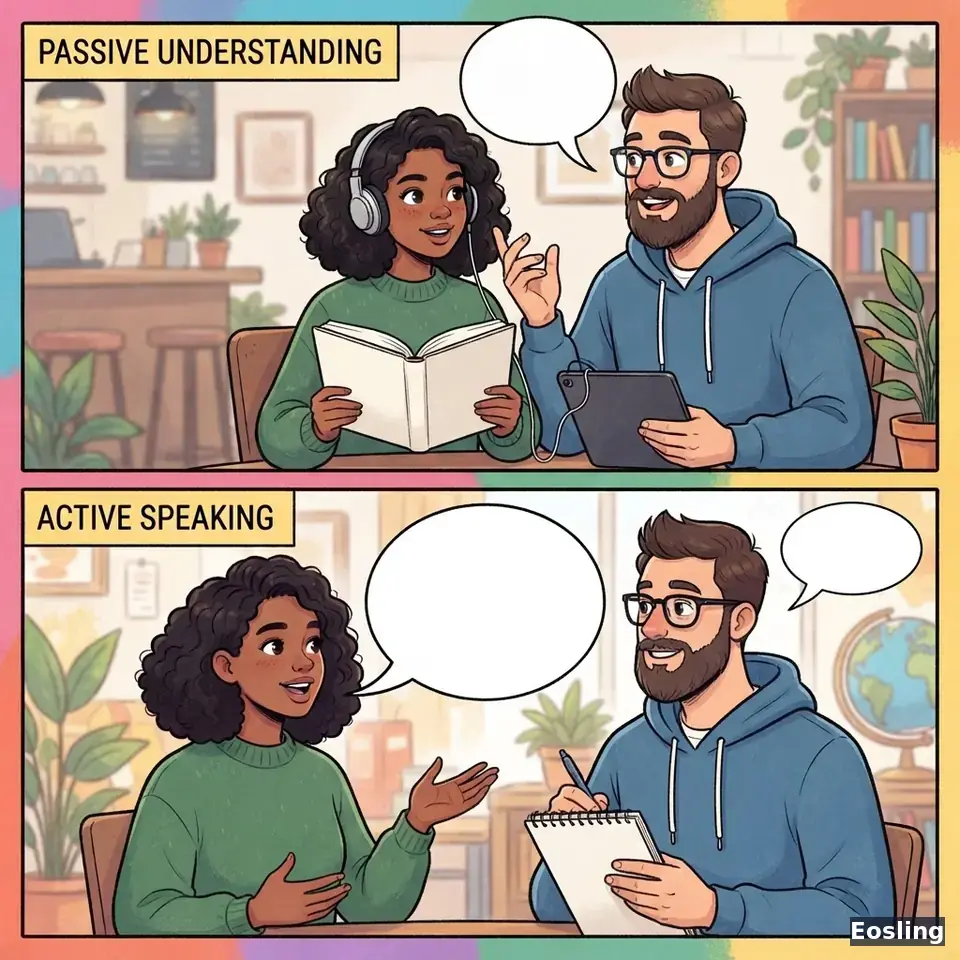
Students come to me with the same confession almost every week: "Dewi, I understand almost everything in your messages, but when I want to reply, my mind goes blank." They can read Saya sudah makan and nod, but when they need to say it themselves, they freeze. This is not a talent problem. It is a gap between two different skills — and if you want to learn Indonesian online, it is the first thing worth understanding.
Indonesian practice
Pronunciation practice
Listen to the phrase, repeat into the mic — your teacher analyzes the audio and gives a real pronunciation score with corrections and comments.
1 / 3
Halo, apa kabar?
hello, how are you?
Why you understand Indonesian but freeze when speaking
Recognition is fast and forgiving. When you read Kami pergi ke pasar besok, your brain matches patterns you have seen before. Production is slower: you must pull the right word from memory, decide on the prefix, and check word order — all before the other person stops talking.
Indonesian has its own traps here. Affixes that look obvious on paper vanish under pressure. You know membeli means "to buy", but mid-sentence you hesitate: was it beli or membeli? Both are correct — Saya beli buku is perfectly natural in speech — but the hesitation itself costs you seconds.
| English | Natural Indonesian | What trips learners up |
|---|---|---|
| I already ate | Saya sudah makan | Forgetting sudah under pressure |
| She is working | Dia sedang bekerja | Choosing sedang vs nothing |
| We go tomorrow | Kami pergi besok | Overthinking the affix |
The fear of mistakes makes it worse. You wait for the perfect sentence, and the moment passes.
Turning what you understand into what you can say
Start with recycling, not inventing. Take a phrase you already recognise and say it out loud about yourself. Read Dia tinggal di Jakarta — now say Saya tinggal di plus your city. Same structure, new content.
Retelling works wonders. Hear or read a short message, then summarise it in three simple sentences. If the original says Kemarin saya pergi ke kantor dan bertemu banyak orang, you say Kemarin saya ke kantor. Saya ketemu banyak orang. Capek. Shorter, simpler, still correct.
Answer familiar questions aloud, even alone. Kamu mau makan apa? — answer Saya mau nasi goreng. Complete sentence beginnings: I say Saya suka… and you finish it. This trains retrieval, not recognition.
Comments
Article discussion: learner comments and Eosling teacher replies
Drop your emotions below — love, debates, even hate welcome. Comment 👇
Don't want to miss my reply? Leave your email — I'll send a copy.