 Talking around unknown words in Indonesian · Dewi · Eosling
Eosling Dewi Blog Talking around unknown words in Indonesian
How to Keep Speaking Indonesian When You Don't Know the Word — Indonesian Lessons
Keep your Indonesian conversation alive when a word escapes you — learn Indonesian online with practical moves to describe, compare, simplify, and ask for help. Indonesian Lessons.
Every learner knows the moment: you're mid-sentence in Indonesian, and the one word you need simply isn't there. The pause stretches, your face goes blank, and the conversation dies. But here's the thing — you don't need every word to be understood, and if you learn Indonesian online, you'll find that a few reliable moves like apa namanya… ("what's it called…") and yang seperti ini ("the one like this") go a long way, plus the confidence to keep going. I've watched students freeze over a missing noun while perfectly good describing words sat unused in their heads. Let's fix that.
Indonesian practice
Pronunciation practice
Listen to the phrase, repeat into the mic — your teacher analyzes the audio and gives a real pronunciation score with corrections and comments.
1 / 3
Halo, apa kabar?
hello, how are you?
Why we freeze — and why it's fixable
Most of us treat conversation like a test with one correct answer. When the exact word won't come, we panic, because we think the sentence is broken. In Indonesian, though, a slightly vague sentence still works fine. The problem isn't your vocabulary — it's the pressure you put on one word.
Notice the difference between stopping dead and steering around the gap:
| English | Natural move | What to avoid |
|---|---|---|
| You forgot "scissors" | Alat untuk memotong kertas (a tool for cutting paper) | Long silence, apologising |
| You forgot "fridge" | Tempat yang dingin untuk makanan (cold place for food) | Switching to English mid-sentence |
| You forgot a verb | Bagaimana cara bilang…? (how do you say…?) | Giving up on the idea |
None of those moves are perfect Indonesian. All of them keep the conversation alive.
Explain it with the words you already have
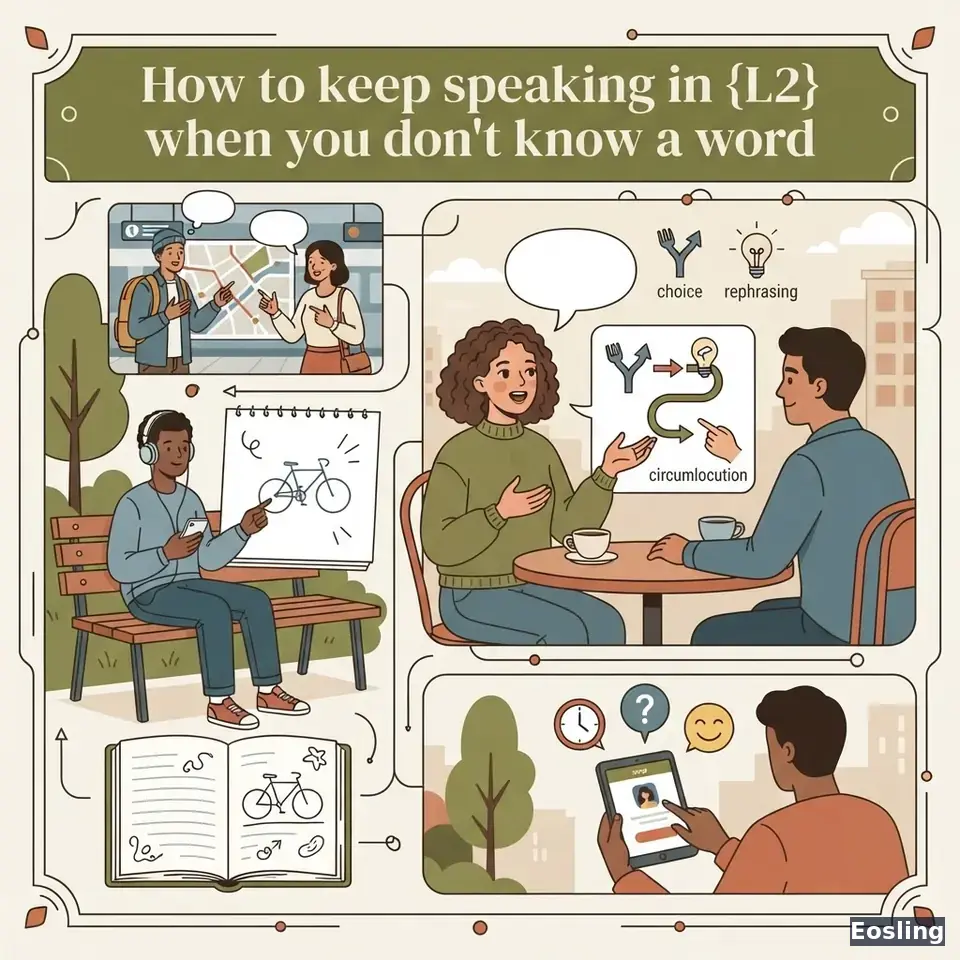
This is the heart of it. When the noun is missing, describe it instead. Talk about bentuknya (its shape), ukurannya (its size), warnanya (its colour), or what it's untuk (for). Give an example: misalnya ("for example"). Compare it to something familiar: seperti ("like") or mirip dengan ("similar to").
A few phrases earn their weight in gold here. Yang seperti ini — "the one like this" — works while you point or gesture. Yang kecil itu — "that small one" — narrows things down. And semacam ("a kind of") lets you be honestly vague: semacam kue ("a kind of cake") is a perfectly respectable answer.
If you're still stuck, ask directly. Apa artinya? ("what does it mean?") and bisa dijelaskan? ("can you explain?") are not failures — they're conversation tools. Native speakers use them too.
Comments
Article discussion: learner comments and Eosling teacher replies
Drop your emotions below — love, debates, even hate welcome. Comment 👇
Don't want to miss my reply? Leave your email — I'll send a copy.