 Dewi · Eosling
How to Stop Translating in Your Head and Start Thinking in Indonesian — Learn To Speak Indonesian
Why your brain keeps translating English into Indonesian, when that habit helps, and practical drills to build direct thinking — learn Indonesian online. Learn To Speak Indonesian.
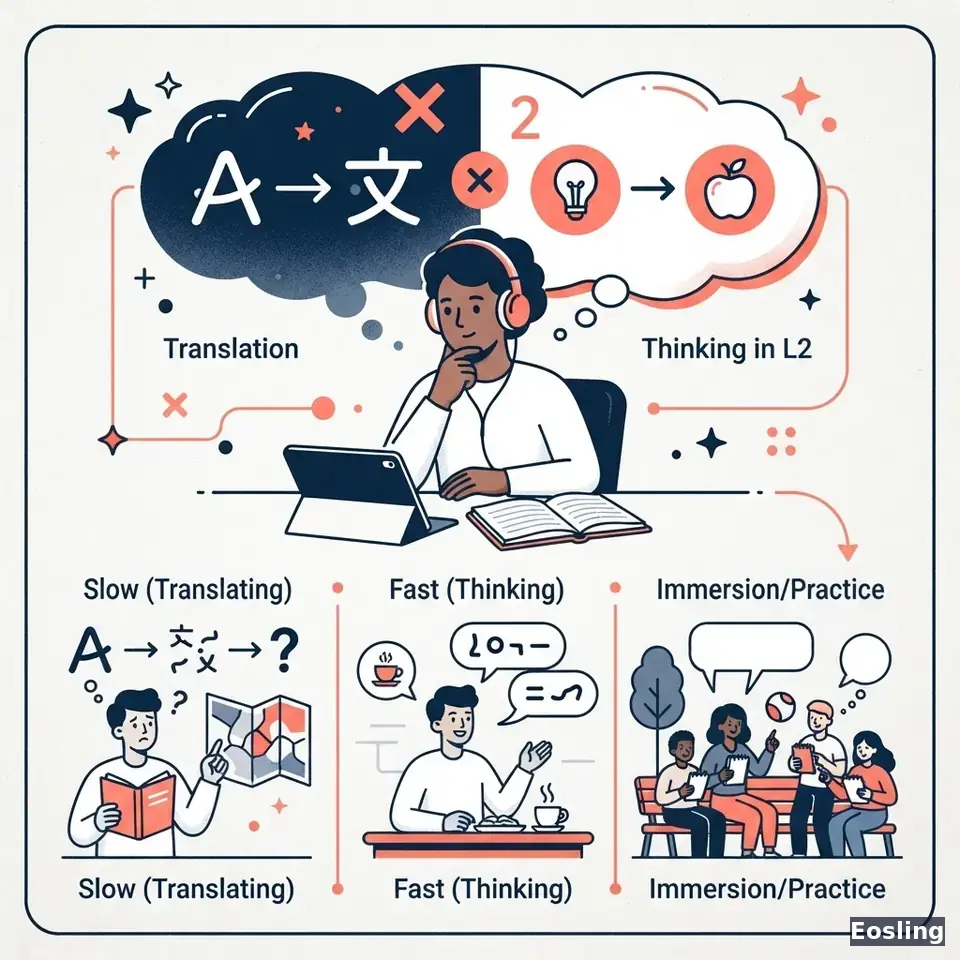
Every week a student says the same thing to me: "Dewi, I understand the words, but by the time I build the sentence in my head, everyone has moved on." That pause is real. It happens because you are doing two jobs at once — thinking the idea in English, then rebuilding it in bahasa Indonesia. If you want to learn Indonesian online, the good news is that the rebuilding stage shrinks with practice, and eventually you just say saya mau makan without ever visiting the word "want" in English first.
Indonesian practice
Pronunciation practice
Listen to the phrase, repeat into the mic — your teacher analyzes the audio and gives a real pronunciation score with corrections and comments.
1 / 3
Halo, apa kabar?
hello, how are you?
Why your brain keeps translating — Speak Indonesian like a local
Your native language is not a bad habit — it is the fastest retrieval system you own. When you need a word, English hands it to you instantly, and your brain then hunts for the Indonesian equivalent. That is a search task, and search tasks are slow.
There is also a structural reason. Indonesian has no verb conjugation for tense or person, so a lot of what English does with grammar, Indonesian does with time words and context. Your brain, trained on English, keeps looking for the endings that should tell it when something happened. They are not coming. So it stalls.
Automaticity is the fix, and it only comes from producing whole chunks many times, not from assembling them fresh each time. Beginners translate more because every word is still a separate search. Intermediate learners translate less — but often at the exact moment they try to say something ambitious, which is when the pause is most noticeable.
When translation helps, and when it gets in the way
Translation is a legitimate tool. As a beginner, checking that saya sudah makan really means "I have eaten" is smart, not lazy. Writing a sentence in English first and then converting it is a fine scaffolding step while you are learning a new structure.
It becomes a problem when it runs during an everyday Indonesian conversation. Some English-to-Indonesian traps worth knowing:
| English | Natural Indonesian | What learners produce |
|---|---|---|
| I am very hungry | Saya sangat lapar | Saya adalah sangat lapar |
| That house is big | Rumah itu besar | Itu rumah adalah besar |
| Where do you live? | Kamu tinggal di mana? | Di mana kamu tinggal? (fine, but stiff) |
| Two books | Dua buku | Dua bukus |
Comments
Article discussion: learner comments and Eosling teacher replies
Drop your emotions below — love, debates, even hate welcome. Comment 👇
Don't want to miss my reply? Leave your email — I'll send a copy.