 Turning passive Hindi understanding into active speaking · Priya · Eosling
Eosling Priya Blog Turning passive Hindi understanding into active speaking
From Understanding Hindi to Actually Speaking It — Hindi Lessons
You follow Hindi conversations and read Devanagari fine, but freeze when it's your turn. Here's why that gap exists and how to close it, step by step. Hindi Lessons.
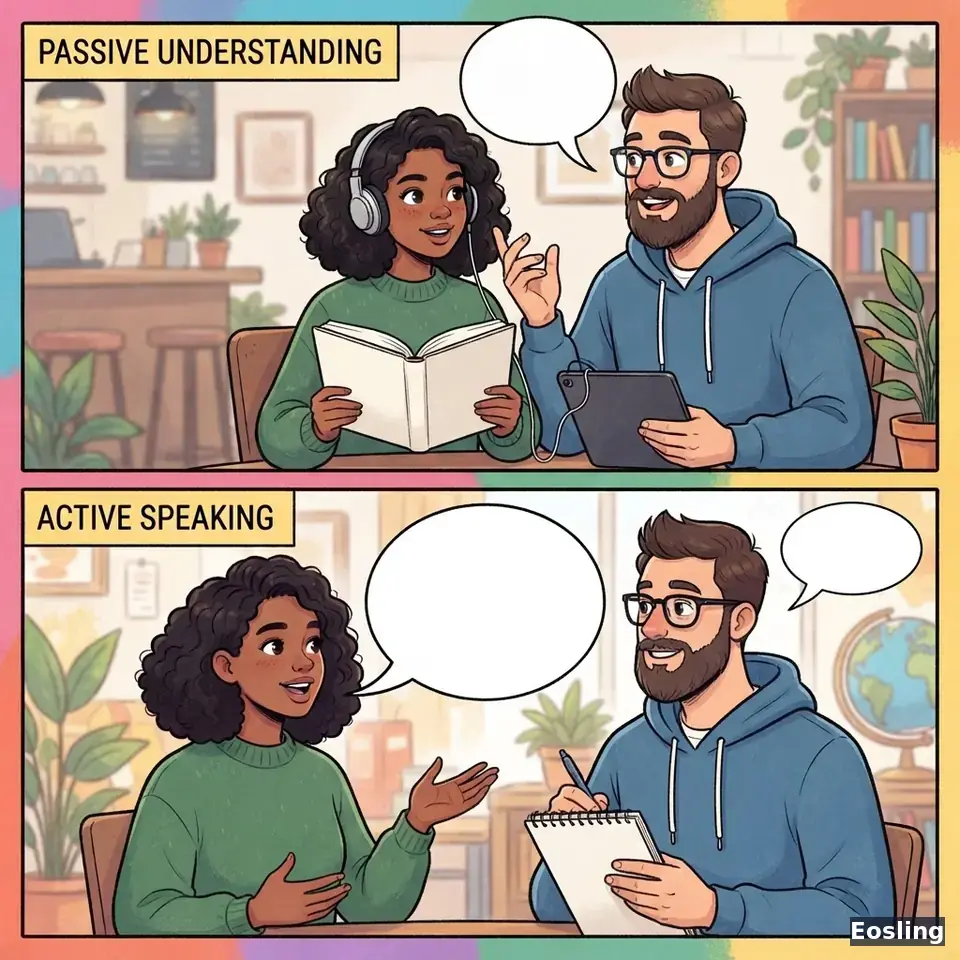
Every Hindi learner hits this wall: you watch a serial and catch मुझे समझ आ गया, you read a message and know कल मिलते हैं means "see you tomorrow" — then someone asks you a question and your mouth produces nothing but a polite smile. I've seen this in dozens of students, and it is not a sign you learned wrong. Recognition and production are two different skills stored differently in your brain. Reading वह घर जाता है and building मैं घर जाता हूँ from scratch are not the same task, even though the words look familiar.
Hindi practice
Pronunciation practice
Listen to the phrase, repeat into the mic — your teacher analyzes the audio and gives a real pronunciation score with corrections and comments.
1 / 3
नमस्ते, कैसे हो?
hello, how are you?
Why you understand but can't speak — Everyday Hindi conversation
When you read or listen, you only need to match — the meaning is already there, and you just confirm it. Speaking requires retrieval: pulling the right word, then the right verb ending, then the right word order, all under time pressure. Hindi makes this extra demanding because the verb sits at the end. You can't start a sentence with a plan and patch it later the way you can in English; you have to hold मैं, कल, बाज़ार and जाऊँगा in your head until the sentence lands.
| English | Hindi pattern | Why it's hard to produce |
|---|---|---|
| I go home | मैं घर जाता हूँ | Gender agreement on the participle |
| I will go tomorrow | मैं कल जाऊँगा | Verb at the very end, future form |
| Do you understand? | तुम्हें समझ आता है? | Dative subject, not "you" as subject |
Notice that in the second sentence, "you" isn't the grammatical doer — तुम्हें is in the oblique. English speakers instinctively build "you understand," and that habit collides with Hindi's structure. That collision is exactly where the freeze happens.
Turning understanding into saying
The bridge is reuse, not invention. Start by stealing whole chunks you already understand and saying them out loud until they're automatic. If you've heard मुझे थोड़ी हिंदी आती है, don't analyse it — say it ten times, then swap one word: मुझे थोड़ी भूख लगी है. Same frame, new content.
A routine that works well:
- Retell in three sentences. Read a short Hindi message, close it, and say what it meant using only words you're sure of. Simple is fine: वह कल आएगा।
- Answer a question you already know. Record yourself answering तुम कहाँ रहते हो? — even if the answer is one line.
- Complete the ending. Take मैं चाहता हूँ कि… and finish it five different ways.
- Shadow a line. Play a slow audio clip and speak along with it, matching rhythm, not just words.
Comments
Article discussion: learner comments and Eosling teacher replies
Drop your emotions below — love, debates, even hate welcome. Comment 👇
Don't want to miss my reply? Leave your email — I'll send a copy.