 Priya · Eosling
How to Remember New Hindi Words and Actually Use Them in Conversation — Hindi Lessons
Learn Hindi online with a practical approach: why you recognise words but freeze when speaking, and how to move them into active use. Hindi Lessons.
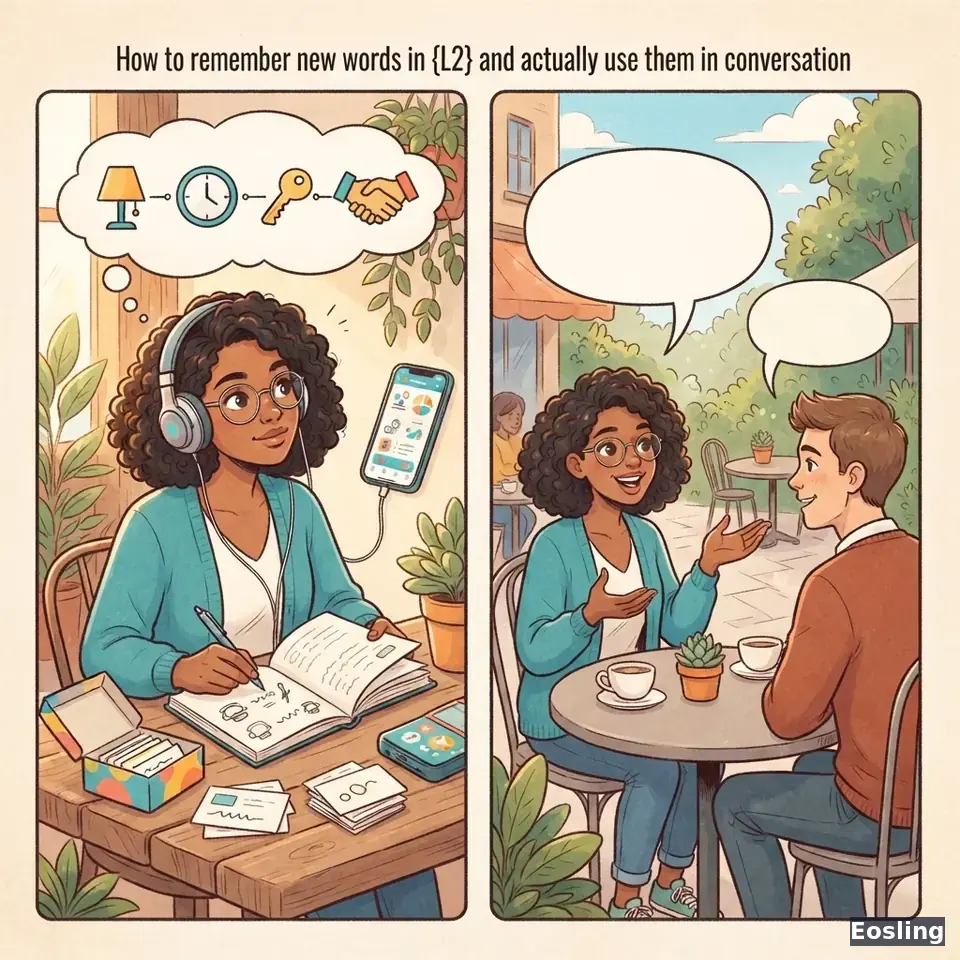
Every Hindi learner knows the moment. You read किताब and instantly think "book." You hear पानी and picture a glass of it. Then someone asks you a simple question and your mind goes blank — the word was right there a second ago. I've watched this happen in my classes for years, and it's almost never a memory problem. It's a retrieval problem. Recognising मुझे भूख लगी है when you see it is one skill; pulling it out of thin air when a friend asks if you've eaten is a completely different one — and it's exactly what you train when you learn Hindi online with a focus on speaking, not just reading.
Hindi practice
Pronunciation practice
Listen to the phrase, repeat into the mic — your teacher analyzes the audio and gives a real pronunciation score with corrections and comments.
1 / 3
नमस्ते, कैसे हो?
hello, how are you?
Why do we recognise words but forget them when speaking?
Reading gives you context for free. The sentence around स्टेशन tells you it's a place, so your brain does half the work. Speaking gives you nothing — just an empty pause and a listener waiting. Add the fact that Hindi word order puts the verb at the end (मैं घर जाता हूँ), and English speakers often stall mid-sentence because they're still waiting for the verb slot to arrive. Your native language isn't sabotaging you; it's just offering a familiar pattern that doesn't fit.
| English | Hindi | Common slip |
|---|---|---|
| I want water | मुझे पानी चाहिए | saying मैं पानी चाहता हूँ |
| I have a book | मेरे पास किताब है | forcing है into the wrong slot |
| Please sit | बैठिए | using बैठो with an elder |
What helps words become part of active vocabulary?
Chunks beat single words, every time. Learn चाय पीना as a unit, not चाय and पीना separately — then मुझे चाय पीनी है arrives almost automatically. Personal associations do the rest: attach थका हुआ to the feeling after a long Monday, and it stops being a dictionary entry. Watch out for respectful forms too. आप कैसे हैं? and तुम कैसे हो? both mean "how are you," but mixing them up sounds odd to a Hindi speaker's ear.
| English | Natural Hindi | Awkward version |
|---|---|---|
| Where are you from? | आप कहाँ से हैं? | तुम कहाँ से हो? to a stranger |
| I'm tired | मैं थका हुआ हूँ | मैं थक गया in the wrong gender |
| Let's go | चलिए | चलो with a respected elder |
Comments
Article discussion: learner comments and Eosling teacher replies
Drop your emotions below — love, debates, even hate welcome. Comment 👇
Don't want to miss my reply? Leave your email — I'll send a copy.