 Priya · Eosling
How to Stop Translating in Your Head and Start Thinking in Hindi — Learn To Speak Hindi
Why your brain keeps translating English into Hindi before you speak — and practical ways to build direct Hindi thinking. Learn Hindi online with confidence. Learn To Speak Hindi.
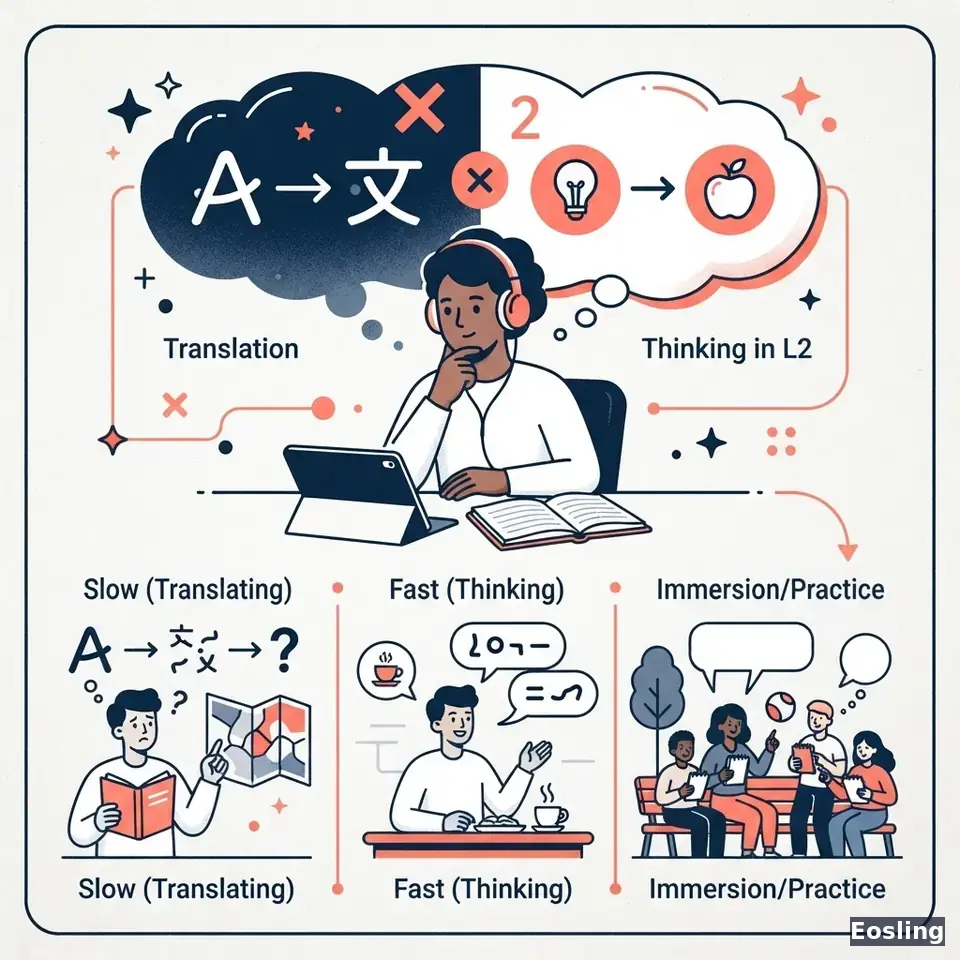
Every Hindi learner I teach hits the same wall: they want to say something simple, and instead their brain runs a tiny translation agency. English sentence in, Hindi sentence out, with a delay you can feel. I hear it in class constantly — students pause, mentally build
Hindi practice
Pronunciation practice
Listen to the phrase, repeat into the mic — your teacher analyzes the audio and gives a real pronunciation score with corrections and comments.
1 / 3
नमस्ते, कैसे हो?
hello, how are you?
Why does the brain keep translating?
Your native language is not a bad habit — it's the fastest retrieval system you own. When you need a word in Hindi, your brain checks the English shelf first because that shelf is fully stocked. For beginners, this is efficient: you know what पानी means because you already have "water." Sentence construction works the same way. Hindi word order is Subject–Object–Verb, so English speakers instinctively want to put the verb early. मैं चाय पीता हूँ ("I drink tea") feels backwards until it doesn't.
Automaticity is the real target. A fluent speaker doesn't decide to use हूँ with मैं — it just arrives. That automaticity comes from repetition, not from willpower. And it differs by level: an A1 learner translating every word is normal; a B1 learner translating every sentence is the habit worth loosening.
When translation helps, and when it gets in the way
Translation is a legitimate learning tool. For grammar, it's often the clearest explanation: Hindi's ने-construction in the past tense (मैंने खाना खाया — "I ate food") makes far more sense when you compare it to English subject-verb logic than when you stare at it alone. Beginners should absolutely lean on translation to understand structure.
The trouble starts when translation becomes the only route to speech. Some patterns simply don't map:
| English | Natural Hindi | Literal translation trap |
|---|---|---|
| I have a book | मेरे पास किताब है | "I have" → मैं रखता हूँ (wrong meaning) |
| I like tea | मुझे चाय पसंद है | "I like" → मैं चाय पसंद करता हूँ (stiff) |
| How old are you? | आपकी उम्र क्या है? | "how old" → कितना पुराना (wrong for people) |
Comments
Article discussion: learner comments and Eosling teacher replies
Drop your emotions below — love, debates, even hate welcome. Comment 👇
Don't want to miss my reply? Leave your email — I'll send a copy.