 Turning French comprehension into speaking · Sophie · Eosling
Eosling Sophie Blog Turning French comprehension into speaking
From Understanding French to Actually Speaking It — French Lessons
You follow French podcasts and read Le Monde, yet freeze when it's your turn to talk. Learn French online and turn passive comprehension into real spoken French, step by step. French Lessons.
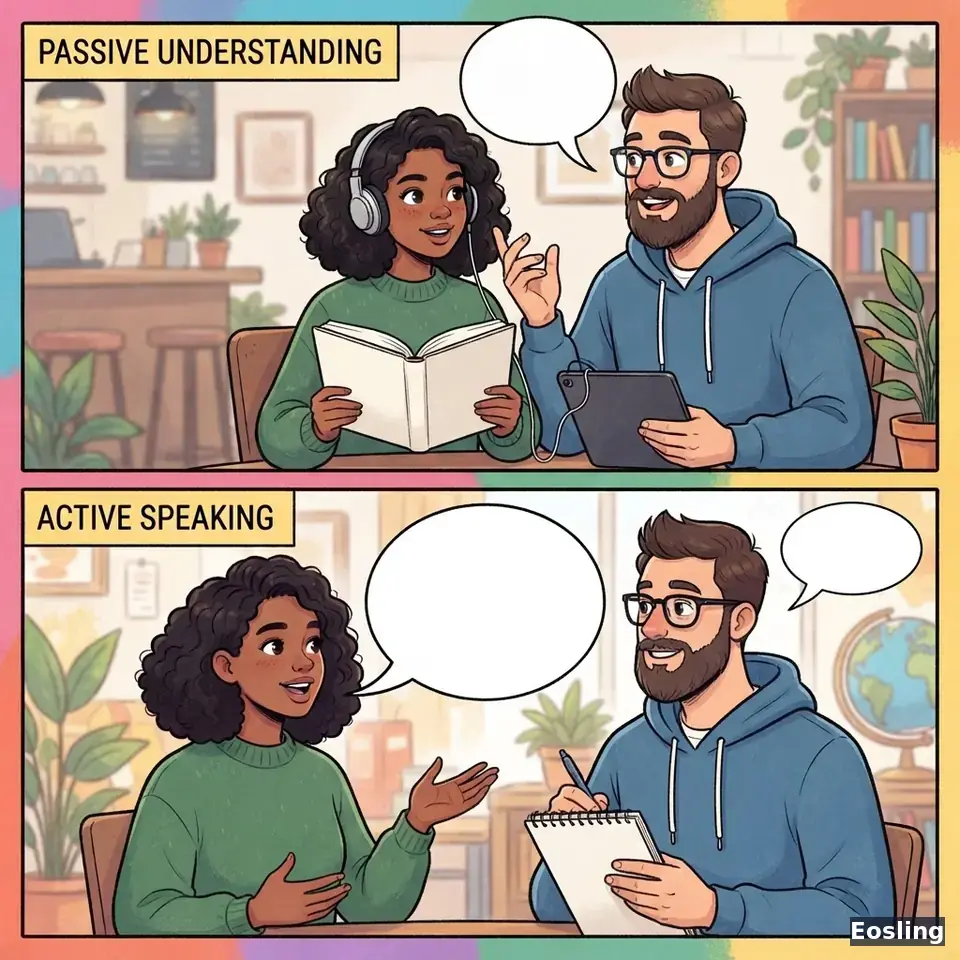
Every week a student tells me the same thing: «I understand everything you say, but when I open my mouth, nothing comes out.» It's the most common frustration in language learning, and it's completely normal. Understanding le français and producing le français are two different skills that live in different parts of your brain. Recognition is fast and forgiving; production is slow and demands choices. When you hear je voudrais un café, s'il vous plaît, you instantly get it. But building that same sentence yourself means retrieving voudrais, remembering the word order, and deciding on politeness — all at once. That is exactly why people who learn French online often read and listen far better than they speak.
French practice
Pronunciation practice
Listen to the phrase, repeat into the mic — your teacher analyzes the audio and gives a real pronunciation score with corrections and comments.
1 / 3
Bonjour, ça va ?
hello, how are you?
Why you understand but can't speak — Everyday French conversation
Passive comprehension is a matching game: the word is in front of you and you recognise it. Speaking is a recall game: you need the word before you have it. That gap is why je comprends mais je ne parle pas feels so unfair. Your vocabulary is stored as «I know this when I see it», not «I can grab it on demand». Add the pressure of real time — French speakers don't wait while you conjugate être and avoir in your head — and the sentence collapses. Fear of mistakes makes it worse: you understand that j'ai allé is wrong, so you hesitate, and the moment passes.
Turning what you understand into what you say
Start with chunks, not grammar puzzles. Take expressions you already recognise and say them out loud until they're automatic: à mon avis, ça dépend, je suis d'accord, c'est pas grave. Then retell something short in your own simple words. Heard a news item? Say hier, il y a eu un accident, mais personne n'est blessé. Complete sentence beginnings: je pense que…, il faut que…, si j'avais le temps…. Reuse phrases from real conversations — if someone said tu veux qu'on se voie demain ?, borrow that exact structure tomorrow.
| English | Useful French chunk |
|---|---|
| In my opinion | à mon avis |
| It depends | ça dépend |
| I agree | je suis d'accord |
| It's no big deal | c'est pas grave |
| I think that… | je pense que… |
Comments
Article discussion: learner comments and Eosling teacher replies
Drop your emotions below — love, debates, even hate welcome. Comment 👇
Don't want to miss my reply? Leave your email — I'll send a copy.