 Sophie · Eosling
How to Stop Translating in Your Head and Start Thinking in French — Learn To Speak French
Learn French online: why your brain keeps translating from English, when that habit helps, and practical ways to build direct thinking in French. Learn To Speak French.
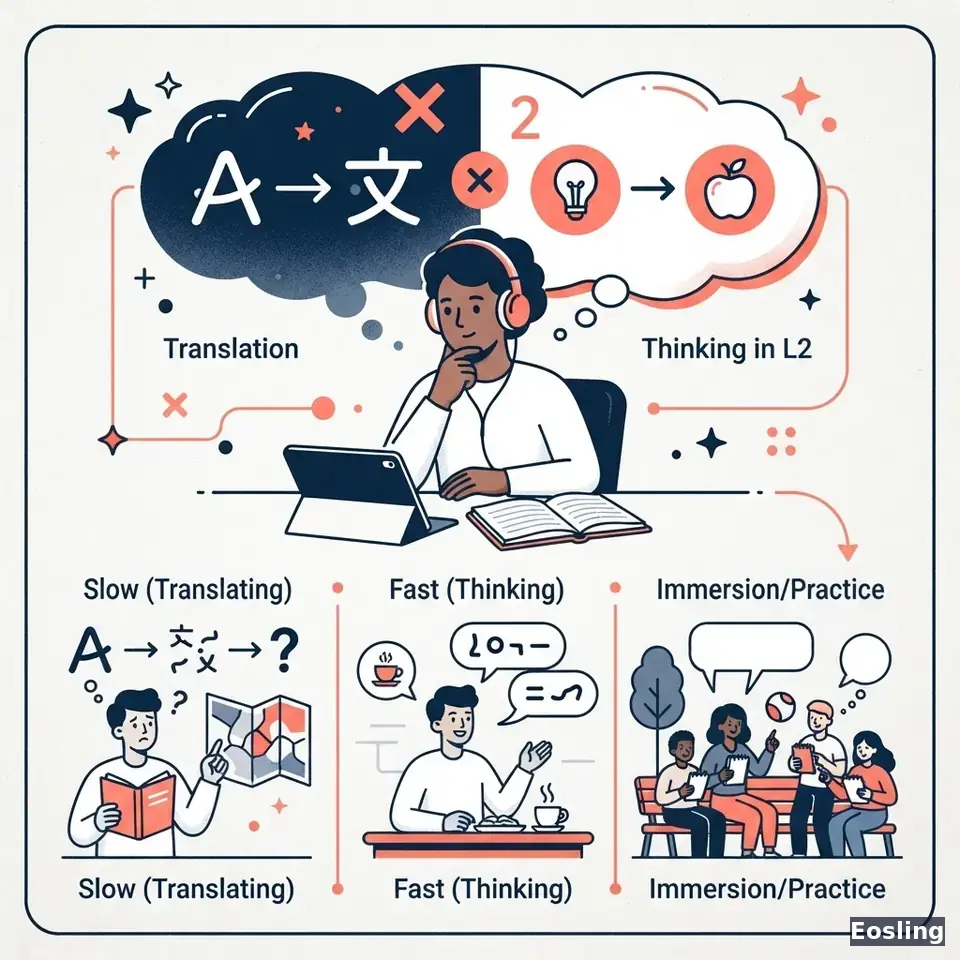
Every English speaker I teach hits the same wall: they want to say something simple, and a small factory in their head starts assembling the sentence in English first. «I have been living here for three years» becomes a word-by-word puzzle:
French practice
Pronunciation practice
Listen to the phrase, repeat into the mic — your teacher analyzes the audio and gives a real pronunciation score with corrections and comments.
1 / 3
Bonjour, ça va ?
hello, how are you?
Why does the brain keep translating?
Because your native language is the fastest road your brain knows. When you need a word, English delivers it instantly; French has to be searched for, and the search takes time. So the brain does the efficient thing: grab the English word, then look up its French twin. This is vocabulary retrieval, and at A1–A2 it is simply how memory works.
The trouble starts with sentence construction. English and French share a lot of vocabulary — roughly a third of English words have French cousins — which tempts learners into word-for-word swaps. But the grammar underneath is different. French needs le, la, les, agrees adjectives (une voiture rouge,
When translation helps, and when it gets in the way
Translation is a genuinely useful learning tool. For beginners, checking a word in a dictionary, comparing depuis with "for/since", or noticing that Tu me manques literally reverses "you are missing to me" builds real understanding. Those contrasts are exactly what makes French memorable.
It gets in the way when you use it as a live production system mid-conversation. Some English shapes simply have no French mirror:
| English | Natural French | Word-for-word trap |
|---|---|---|
| I've been living here for three years | J'habite ici depuis trois ans | je ai été vivant… |
| I miss you | Tu me manques | je te manque (wrong meaning!) |
| It makes me laugh | Ça me fait rire | ça me rend rire |
| I'm looking forward to it | J'ai hâte | je regarde en avant |
Comments
Article discussion: learner comments and Eosling teacher replies
Drop your emotions below — love, debates, even hate welcome. Comment 👇
Don't want to miss my reply? Leave your email — I'll send a copy.