 Describing around missing French words · Sophie · Eosling
Eosling Sophie Blog Describing around missing French words
How to Keep Talking in French When the Word Just Won't Come — French Lessons
Learn French online with practical strategies to keep a conversation alive when you forget a word — describe, compare, simplify, and ask for help without switching to English. French Lessons.
We've all been there. You're mid-sentence in French, the conversation is flowing, and then — nothing. The word for «screwdriver» has evaporated. Your brain sounds the alarm, your sentence stalls, and you reach for the emergency exit: English. The good news is that freezing isn't a vocabulary problem, it's a habit problem. You don't need the exact word to keep going, and that's one of the first things you pick up when you learn French online. You need
French practice
Pronunciation practice
Listen to the phrase, repeat into the mic — your teacher analyzes the audio and gives a real pronunciation score with corrections and comments.
1 / 3
Bonjour, ça va ?
hello, how are you?
Why do we freeze in the first place? — Speak French like a local
Most learners treat a missing word like a wall. In reality it's a pothole — you can steer around it. The freeze usually comes from three things: hunting for the perfect word, fearing a grammar slip, and the quiet belief that an unfinished sentence is a failed sentence. French makes this worse for English speakers because we often suspect the word exists as a cognate and we just can't retrieve it. You know une vis is a screw, but the tool? Gone.
Here's the reframe: a French speaker listening to you cares about your meaning, not your lexicon. If you say c'est un outil pour tourner les vis — it's a tool for turning screws — they'll hand you the word (un tournevis) before you've even finished. That's not failure. That's communication working.
How to explain an idea with the words you already have
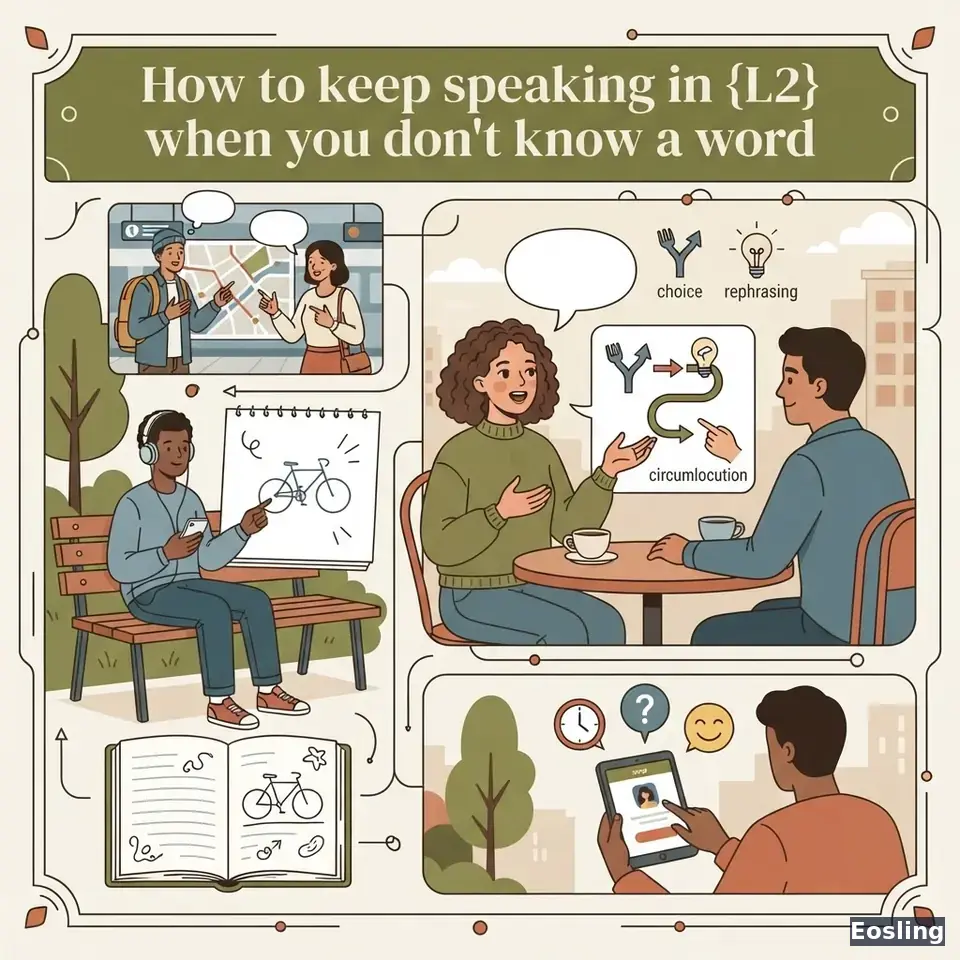
The trick is to have a small toolkit ready before you need it. Four moves cover almost everything:
| English strategy | Natural French phrase |
|---|---|
| Describe its purpose | C'est un truc pour… (it's a thing for…) |
| Describe how it looks | C'est comme… mais en plus petit (it's like… but smaller) |
| Simplify the idea | En fait, c'est simple : … (actually, it's simple: …) |
| Ask for the word | Comment on dit… ? / Ça s'appelle comment ? |
Notice that un truc is your best friend here. It's casual, flexible, and buys you time — a bit like saying «thingy» in English, but perfectly acceptable in everyday French conversation. And Comment on dit… ? is not an admission of defeat; native speakers use it constantly.
How to practise staying in the conversation
You can't rehearse every missing word, but you can rehearse the recovery. Try these three exercises, five minutes each:
Comments
Article discussion: learner comments and Eosling teacher replies
Drop your emotions below — love, debates, even hate welcome. Comment 👇
Don't want to miss my reply? Leave your email — I'll send a copy.