 Mei · Eosling
Why Real Chinese Sounds Nothing Like Your Textbook (And How to Fix It) — Speak Chinese
Understand why textbook Mandarin dialogues feel clear but native speakers don't — and learn practical ear-training techniques for connected speech, tones in context, and real speed. Speak Chinese.
Every learner hits the same wall. You can read a dialogue about ordering tea perfectly, you know wǒ yào yī bēi chá by heart, and then a real person opens their mouth and it's a blur of sounds you don't recognise. Nothing is wrong with you. Textbook Mandarin is recorded slowly, word by word, with every tone polished. Real speech is fast, glued together, and full of shortcuts. The gap between duìbuqǐ as printed and duìbuqǐ as mumbled on a busy street is enormous — and it's learnable.
Chinese practice
Pronunciation practice
Listen to the phrase, repeat into the mic — your teacher analyzes the audio and gives a real pronunciation score with corrections and comments.
1 / 3
你好吗?
nǐ hǎo ma?
hello, how are you?
What makes natural Mandarin hard to catch — Everyday Chinese conversation
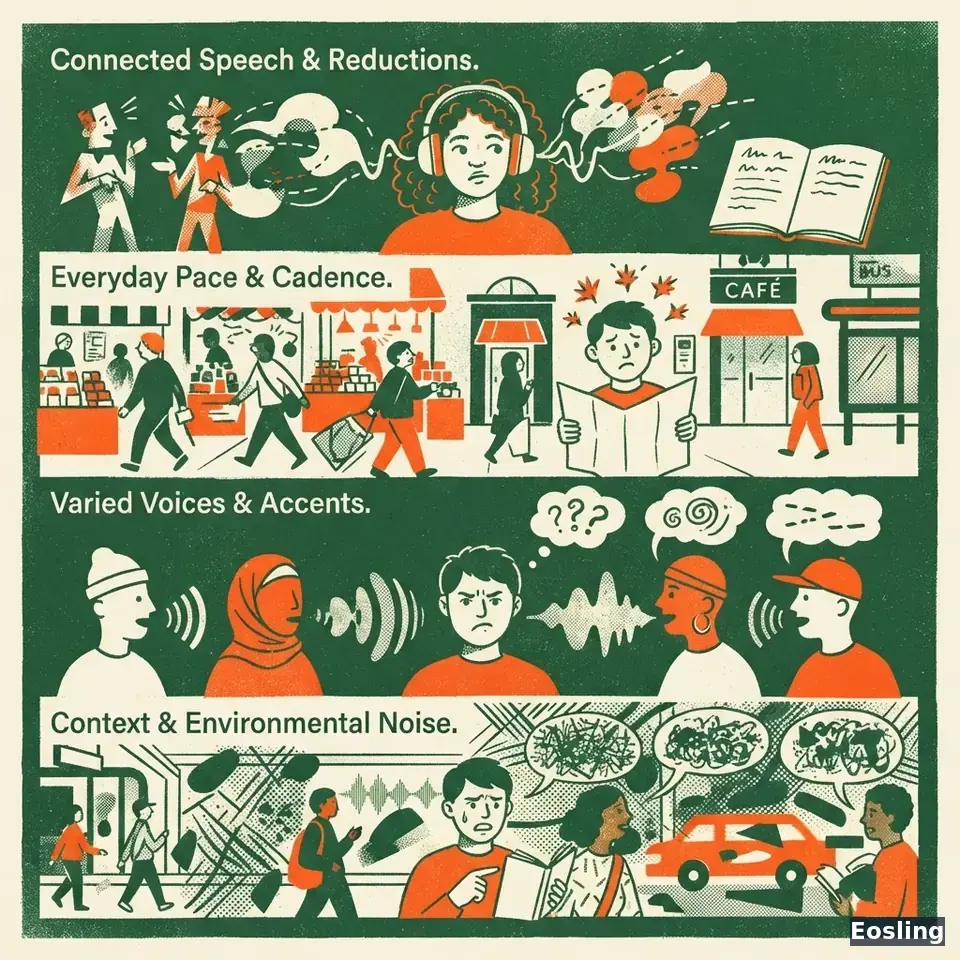
Chinese doesn't reduce sounds the way English does — no "gonna" for "going to" — but it compresses in its own way. The biggest culprits:
- Neutral tone erasure. In nǐ hǎo ma, that ma nearly vanishes. In zhī dào le ma, the le and ma become tiny. Learners trained on full tones miss them entirely.
- Tone sandhi. Two third tones in a row: nǐ hǎo is actually pronounced ní hǎo. Three third tones: wǒ hěn hǎo becomes wó hén hǎo. Your brain hears tones that don't match the dictionary and panics.
- Speed and syllable merging. Duō shao qián at natural pace sounds like dwshao qián. Zhè ge becomes zhèi ge in the north. Bù zhī dào softens to bùr dào in casual Beijing speech.
- Regional variation. A Taiwanese speaker's zhī sounds closer to zī; a Sichuan speaker may drop the n/ng distinction. These are accents, not errors — but they multiply your listening load.
| English | Textbook form | Natural speech |
|---|---|---|
| How much is it? | duō shao qián | dwshao qián |
| I don't know | bù zhī dào | bùr dào |
| This one | zhè ge | zhèi ge |
| You're welcome | bú kè qi | bú kè qi (fast, clipped) |
wǒ hěn hǎo nǐ hǎo ma duō shao qián bù zhī dào
How English habits help — and hurt
English is stress-timed: we lean on stressed syllables and swallow the rest. That habit actually helps you skim for keywords in Chinese, because content words (chá, qián, míngtiān) pop out. But English speakers also expect pitch to carry emotion, not meaning. In Mandarin, pitch is the word. When a native speaker's rising question intonation collides with a second-tone word, English ears hear "question" instead of "the tone changed the word." You also expect clear word boundaries — English has them, Chinese doesn't. Wǒ yào qù runs together as one stream, and there's no pause telling you where wǒ ends and yào begins.
Comments
Article discussion: learner comments and Eosling teacher replies
Drop your emotions below — love, debates, even hate welcome. Comment 👇
Don't want to miss my reply? Leave your email — I'll send a copy.