 Passive Chinese comprehension to active speaking · Mei · Eosling
Eosling Mei Blog Passive Chinese comprehension to active speaking
From Understanding to Speaking Chinese: A Practical Bridge — Chinese Lessons
You understand a lot of Chinese but freeze when it's your turn to talk. Learn Chinese online and close the gap with small, honest steps. Chinese Lessons.
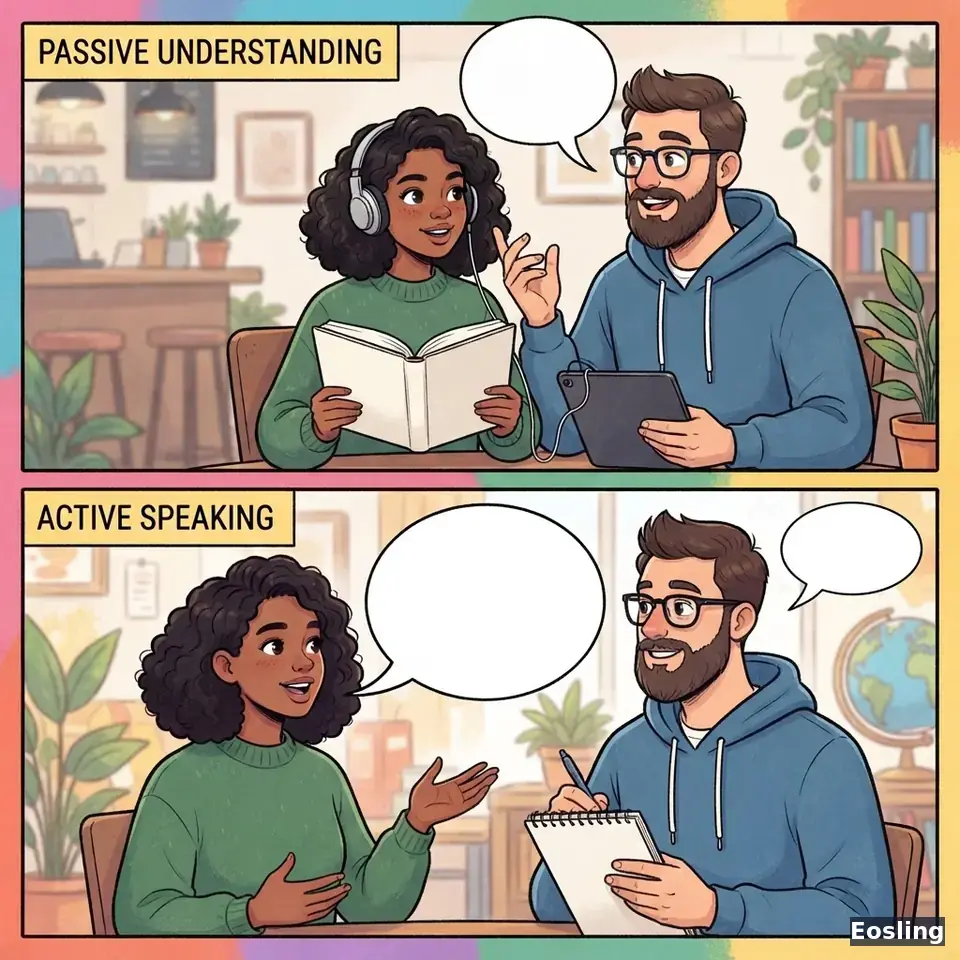
Every week a student tells me the same thing: "I watch dramas without subtitles, I read the news, I get every word — but when someone asks me a question, my mouth is empty." I hear you. Understanding nǐ hǎo ma and producing wǒ hěn hǎo, xièxie are two completely different skills, and nobody warns you about the gap between them — which is exactly why so many people decide to learn Chinese online and still hit this wall.
Chinese practice
Pronunciation practice
Listen to the phrase, repeat into the mic — your teacher analyzes the audio and gives a real pronunciation score with corrections and comments.
1 / 3
你好吗?
nǐ hǎo ma?
hello, how are you?
Why you understand Chinese but freeze when speaking
Recognition is cheap; retrieval is expensive. When you read wǒmen míngtiān qù kàn diànyǐng you just need to match patterns you've seen before. When you speak, you have to pull míngtiān out of storage, decide the word order, pick the right measure word, and get the tones out of your mouth — all in under a second. That's a lot of parallel work.
Chinese adds its own friction. You can't lean on cognates the way a Spanish learner leans on English. Tones are physical, not just mental: you know mǎi means "buy" and mài means "sell", but your tongue has to cooperate in real time. And because Chinese verbs don't conjugate, learners often assume grammar is "easy" — then discover that word order and particles like le, guò, de carry the load that tense endings carry in English.
There's also the shame factor. Adults hate sounding like toddlers. But a toddler who says wǒ yào shuǐ gets water; an adult who says it gets embarrassed. That embarrassment is the real bottleneck, not your vocabulary.
Turning what you understand into what you can say
Start with recycling, not creating. Take a sentence you already understand — say, wǒ juéde zhège bǐjiào hǎo — and swap one slot: wǒ juéde zhège bǐjiào guì. Same skeleton, new skin. This is called sentence frames, and it works because you're not inventing grammar, just filling boxes.
Retelling is the second tool. Read a two-line message, close it, and say it back in your own simple words. If the original was tā shuō tā míngtiān bù lái le, your version can be tā míngtiān bù lái. Shorter is fine. Shorter is good.
Third, answer familiar questions out loud — alone. Nǐ zhōumò zuò shénme? → Wǒ zhōumò qù mǎi dōngxi, ránhòu zài jiā kàn shū. You're not performing; you're rehearsing. Record it, listen once, notice one thing to fix, move on.
A quick comparison of what actually helps:
Comments
Article discussion: learner comments and Eosling teacher replies
Drop your emotions below — love, debates, even hate welcome. Comment 👇
Don't want to miss my reply? Leave your email — I'll send a copy.