 Mei · Eosling
How to Stop Translating in Your Head and Start Thinking in Chinese — Learn To Speak Chinese
Why your brain keeps translating English into Chinese before you speak — and practical ways to learn Chinese online with more direct thinking, one small habit at a time. Learn To Speak Chinese.
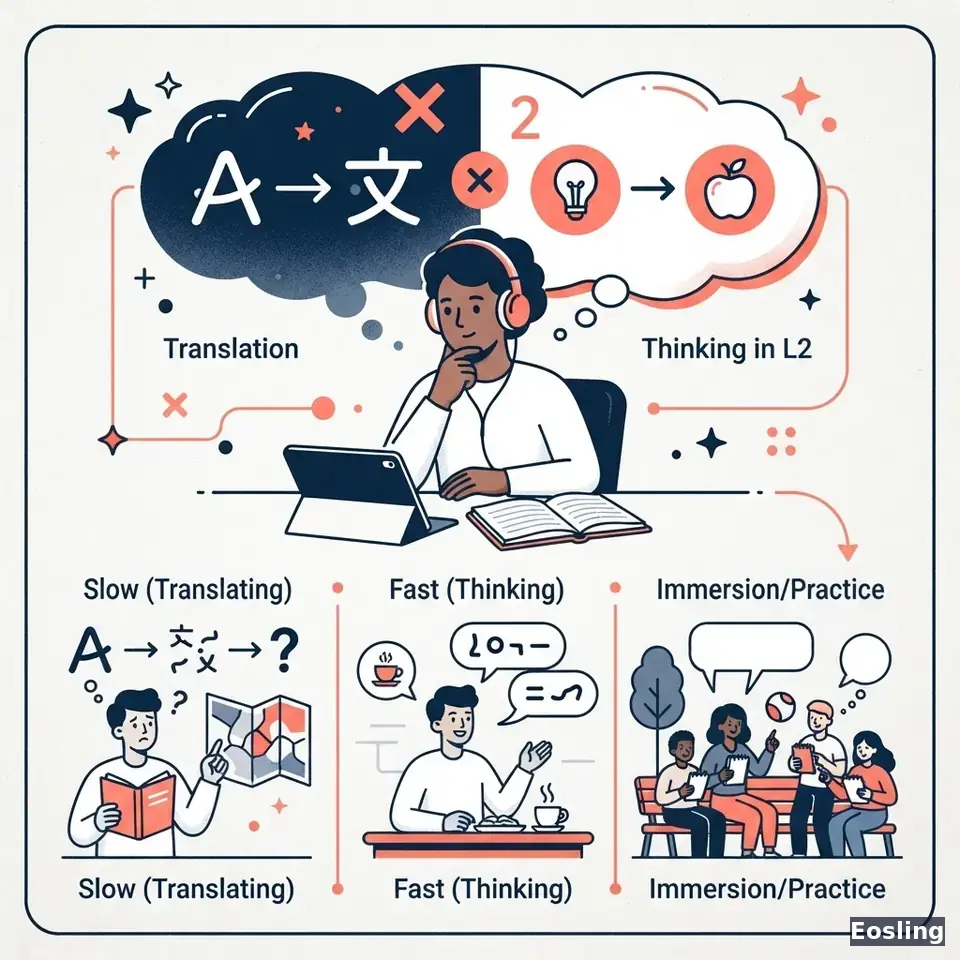
Every learner knows the pause. You want to say something simple, and your brain runs the whole assembly line: English thought, English sentence, word-by-word swap, then a nervous check. By the time you produce 我觉得这个很好, the conversation has moved on. I hear this constantly in class, and I always tell students the same thing: translation isn't a character flaw. It's just the shortcut your brain takes while it's still building a faster road — and it's one of the first things we work on when you learn Chinese online.
Chinese practice
Pronunciation practice
Listen to the phrase, repeat into the mic — your teacher analyzes the audio and gives a real pronunciation score with corrections and comments.
1 / 3
你好吗?
nǐ hǎo ma?
hello, how are you?
Why does the brain keep translating?
Your native language is the loudest voice in the room. When you reach for a word in Chinese, your memory often retrieves the English label first, because that link is decades old and worn smooth. Then you assemble the sentence using English grammar and patch it with Chinese vocabulary. That's why beginners produce things like 我很喜欢喝茶 correctly but freeze on 我把茶喝了 — the first maps neatly onto English word order, the second doesn't.
Automaticity is the real goal. A native speaker doesn't "choose" 了; it arrives with the meaning. For English speakers, the biggest bottlenecks are usually tone, measure words, and aspect markers, because English gives you no equivalent scaffolding to lean on. Until those become automatic, translation is doing the heavy lifting.
When translation helps, and when it gets in the way
Translation is a genuinely useful tool. For beginners, checking a new word against English builds meaning fast, and understanding a grammar explanation in your own language saves hours. The trouble starts when you translate every sentence during real communication.
| English | Natural Chinese | Word-by-word trap |
|---|---|---|
| I've studied Chinese for two years | 我学中文两年了 | 我已经学习中文为了两年 |
| Where are you from? | 你是哪国人? | 你来自哪里? |
| This is too expensive | 这个太贵了 | 这个太昂贵 |
The pattern is clear: literal swaps produce grammatical Chinese that no one actually says. 你来自哪里 isn't wrong, but it sounds like a form. 你是哪国人 is what a friend asks.
Comments
Article discussion: learner comments and Eosling teacher replies
Drop your emotions below — love, debates, even hate welcome. Comment 👇
Don't want to miss my reply? Leave your email — I'll send a copy.