 Passive understanding vs active speaking in Spanish · Lucía · Eosling
Eosling Lucía Blog Passive understanding vs active speaking in Spanish
From Understanding Spanish to Actually Speaking It — Spanish Lessons
Why you understand Spanish but freeze when it's your turn to talk — learn Spanish online with three practical steps from passive comprehension to real speech. Spanish Lessons.
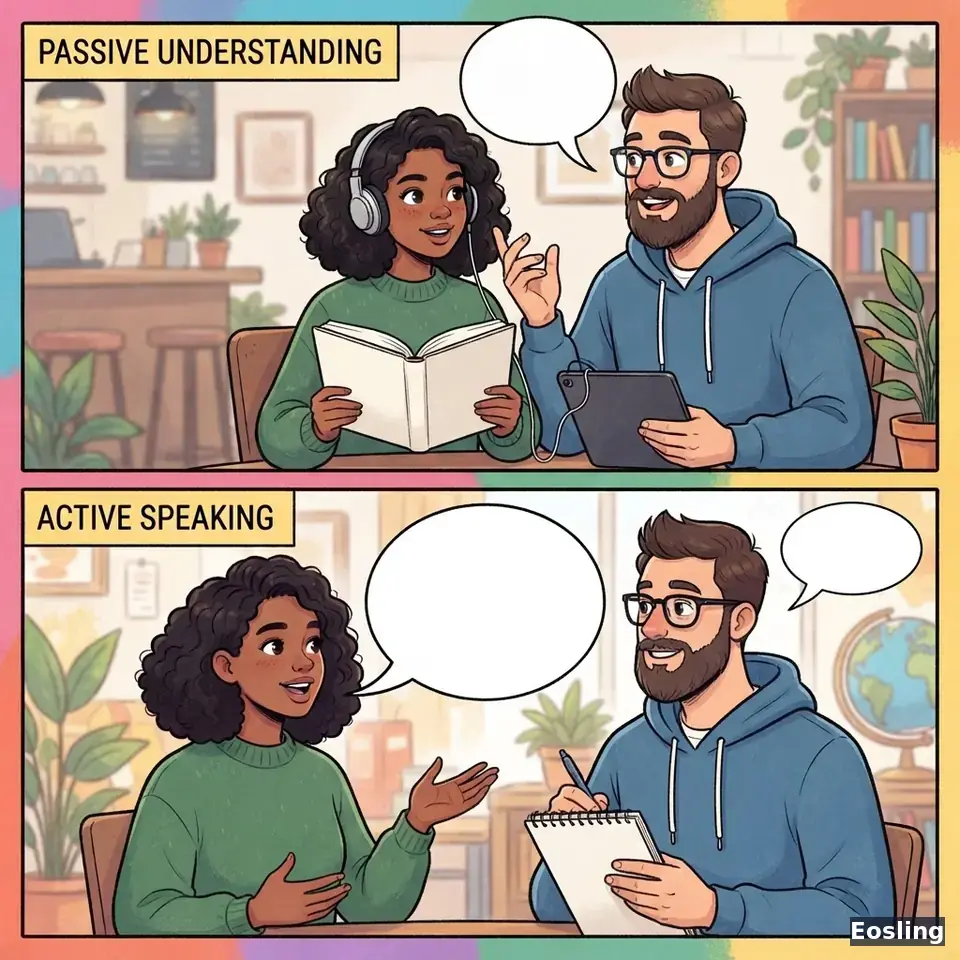
Students tell me this all the time: they follow my podcast, they read the news in Spanish, they laugh at chistes in series — and then someone asks them a simple question and they produce nothing but ehhh. That gap is real, and it's not a character flaw. Understanding and speaking are two different skills that live in different parts of your brain's language machinery — and if you want to learn Spanish online, the second skill needs its own practice.
Spanish practice
Pronunciation practice
Listen to the phrase, repeat into the mic — your teacher analyzes the audio and gives a real pronunciation score with corrections and comments.
1 / 3
Hola, ¿cómo estás?
hello, how are you?
Why you understand Spanish but can't speak it yet — Everyday Spanish conversation
Recognising a word is a cheap operation: it's there in front of you, and your brain matches it to a meaning. Producing it is expensive: you have to retrieve it from memory, choose a form, put it in the right place, and do it fast enough to keep the conversation alive. That's why entiendo todo pero no hablo is such a common confession.
There's also the retrieval problem. Passive vocabulary sits in a warehouse with no search system. You know la nevera when you see it, but when you need to say "put it in the fridge", your brain offers nothing. And then there's fear: you know the subjunctive exists, you know si tuviera tiempo is more elegant than a clumsy workaround, so you hesitate — and hesitation kills the sentence.
How to turn what you understand into what you say
Stop trying to build sentences from scratch. Steal them. When you hear a useful chunk, repeat it aloud immediately, then again an hour later, then use it in a message to yourself.
| What you heard | What you say out loud |
|---|---|
| ¿Me puedes echar una mano? | Claro, ahora mismo. |
| ¿Qué tal el finde? | Bien, tranquilo. ¿Y el tuyo? |
| No me acaba de convencer. | A mí tampoco, la verdad. |
Retelling works wonders too. Read a short news item, close it, and retell it in three sentences using only words you're sure of: Un hombre encontró un perro. El perro estaba perdido. Ahora buscan a su dueño. Ugly? Maybe. Functional? Completely.
How to get comfortable speaking, gradually
Set a tiny daily routine. Two minutes, no more. Describe what's in front of you: En la mesa hay una taza, un cuaderno y las llaves. Answer one question aloud — ¿Qué has desayunado hoy? — and record it on your phone. Listening back is uncomfortable for about a week, then it becomes useful data.
Comments
Article discussion: learner comments and Eosling teacher replies
Drop your emotions below — love, debates, even hate welcome. Comment 👇
Don't want to miss my reply? Leave your email — I'll send a copy.