 Keeping Spanish conversation going without the exact wor · Lucía · Eosling
Eosling Lucía Blog Keeping Spanish conversation going without the exact wor
How to Keep Talking in Spanish When the Word Just Won't Come — Spanish Lessons
A Spanish teacher's practical guide to surviving the blank-word moment: describe, compare, simplify and ask — learn Spanish online and keep the conversation alive. Spanish Lessons.
Every conversation in Spanish eventually hits the same wall. You're mid-sentence, everything is flowing, and then — nothing. The word for "screwdriver" or "receipt" or "landlord" has vanished. If you've ever frozen in a café thinking no sé cómo se dice ("I don't know how to say it"), this article is for you: if you want to learn Spanish online, the first lesson is that the goal isn't a perfect sentence — it's staying in the conversation.
Spanish practice
Pronunciation practice
Listen to the phrase, repeat into the mic — your teacher analyzes the audio and gives a real pronunciation score with corrections and comments.
1 / 3
Hola, ¿cómo estás?
hello, how are you?
Why do we freeze in the first place?
Most learners don't stop because the conversation is over. They stop because they're hunting for one exact word and treating everything else as failure. The brain locks onto the missing piece, the pause stretches, and confidence drains. Notice the difference: "I need the word destornillador or I can't continue" versus "I need to make myself understood." The first is a vocabulary test; the second is communication.
A small but useful shift is to narrate the gap out loud instead of going silent. Phrases like es que no me sale la palabra ("the word just won't come out") or ¿cómo se dice…? buy you time and keep the other person with you. Freezing feels like politeness; in reality, a short honest phrase sounds far more natural than ten seconds of silence.
Explaining an idea with the words you already have
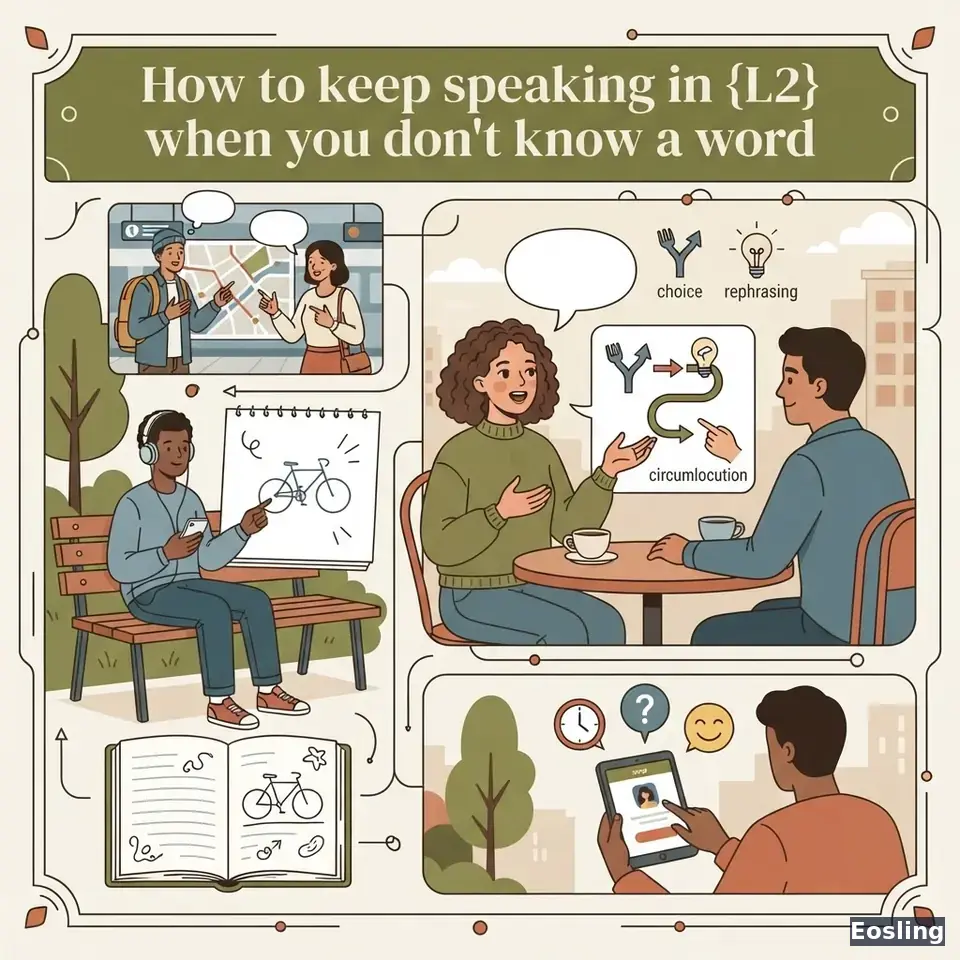
The trick is to describe around the missing word. Talk about what the object looks like, what it's for, or what it's similar to. If you forget el sacacorchos, you can say es un aparato para abrir botellas de vino — "it's a gadget for opening wine bottles." That's not a failure; that's real Spanish doing real work.
| Strategy | English | Spanish you can say |
|---|---|---|
| Describe the purpose | It's for opening bottles | Es para abrir botellas |
| Compare with something familiar | It's like a big spoon | Es como una cuchara grande |
| Give an example | Something like a hammer | Algo así como un martillo |
| Simplify | The thing you use to pay | Lo que usas para pagar |
| Ask for help | How do you say it? | ¿Cómo se dice? |
A word of honesty: asking for a translation is not cheating. ¿Cómo se dice "receipt" en español? is a perfectly normal question, and Spanish speakers ask it of each other too. The skill is to try describing first, then ask — you'll remember the word better when you've circled it yourself.
Comments
Article discussion: learner comments and Eosling teacher replies
Drop your emotions below — love, debates, even hate welcome. Comment 👇
Don't want to miss my reply? Leave your email — I'll send a copy.