 Галина · Eosling
How to Stop Translating in Your Head and Start Thinking in Russian — Learn To Speak Russian
Why your brain keeps translating from English into Russian, when that habit helps, and practical drills to think directly — learn Russian online with a teacher's guidance. Learn To Speak Russian.
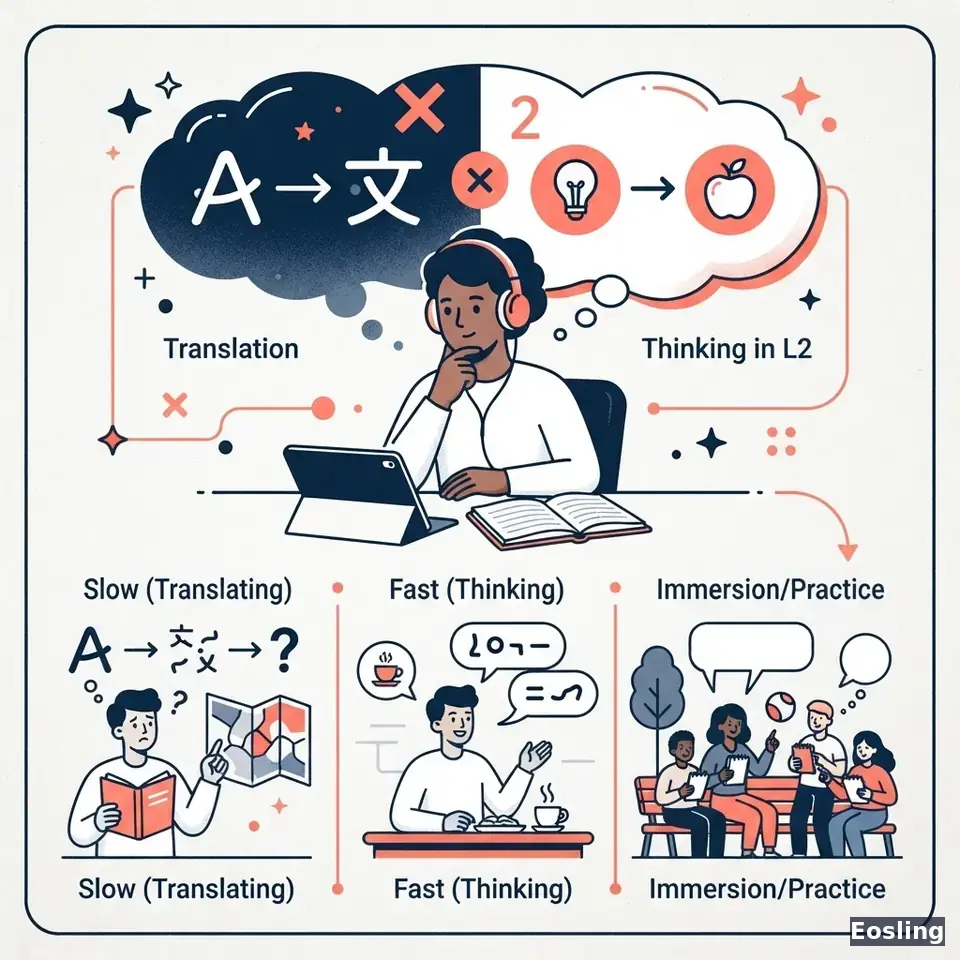
Almost every learner I meet apologises for the same thing: "I still build the sentence in English first." Good news — that is not a flaw, it is a stage. Your brain reaches for the familiar route because it is fast and safe. The goal is not to delete English from your head, but to make
Russian practice
Pronunciation practice
Listen to the phrase, repeat into the mic — your teacher analyzes the audio and gives a real pronunciation score with corrections and comments.
1 / 3
Привет, как дела?
hello, how are you?
Why does the brain keep translating? — Everyday Russian conversation
Translation is a retrieval strategy. When you need a word, your memory searches the fastest index it has — your native language — and then looks for a Russian equivalent. For beginners this is efficient: you have thousands of English concepts mapped and very few Russian ones. Automaticity comes later, and only through repetition, not through willpower.
Russian makes the detour especially tempting because the mapping is rarely one-to-one. English "I have" becomes у меня есть — literally "by me there is". English "I like" becomes мне нравится, where the person is in the dative case. If you translate word by word, you get a sentence that is grammatically alive but sounds like a machine.
| English | Natural Russian | Word-by-word trap |
|---|---|---|
| I have a brother | У меня есть брат | Я имею брата |
| I like this book | Мне нравится эта книга | Я люблю эту книгу |
| I am 20 years old | Мне двадцать лет | Я есть двадцать лет |
| I don't have time | У меня нет времени | Я не имею время |
When translation helps, and when it gets in the way
Translation is a legitimate learning tool. At A1–A2 it helps you decode grammar: seeing that я читаю книгу maps to "I am reading a book" gives you a hook. It also saves you in emergencies — better a translated sentence than silence.
It starts to hurt when it becomes the default for every utterance. Three symptoms: you pause mid-sentence hunting for the "right" equivalent; you produce correct but unnatural phrasing; you freeze in conversation because the English sentence was too complex to convert in real time. The fix is not to ban translation but to notice when it is costing you fluency.
| Situation | Translate? | Why |
|---|---|---|
| Reading grammar explanations | Yes | Builds understanding |
| Writing a first draft | Sometimes | Then revise for naturalness |
| Small talk, quick replies | No | Speed matters more than perfection |
| Looking up a single noun | Yes | Efficient retrieval |
Comments
Article discussion: learner comments and Eosling teacher replies
Drop your emotions below — love, debates, even hate welcome. Comment 👇
Don't want to miss my reply? Leave your email — I'll send a copy.