 Staying fluent in Russian without the exact word · Галина · Eosling
Eosling Галина Blog Staying fluent in Russian without the exact word
How to Keep Talking in Russian When the Word Just Won't Come — Russian Lessons
Learn Russian online with practical strategies for keeping a conversation alive when you forget a word — describe, simplify, ask — instead of freezing mid-sentence. Russian Lessons.
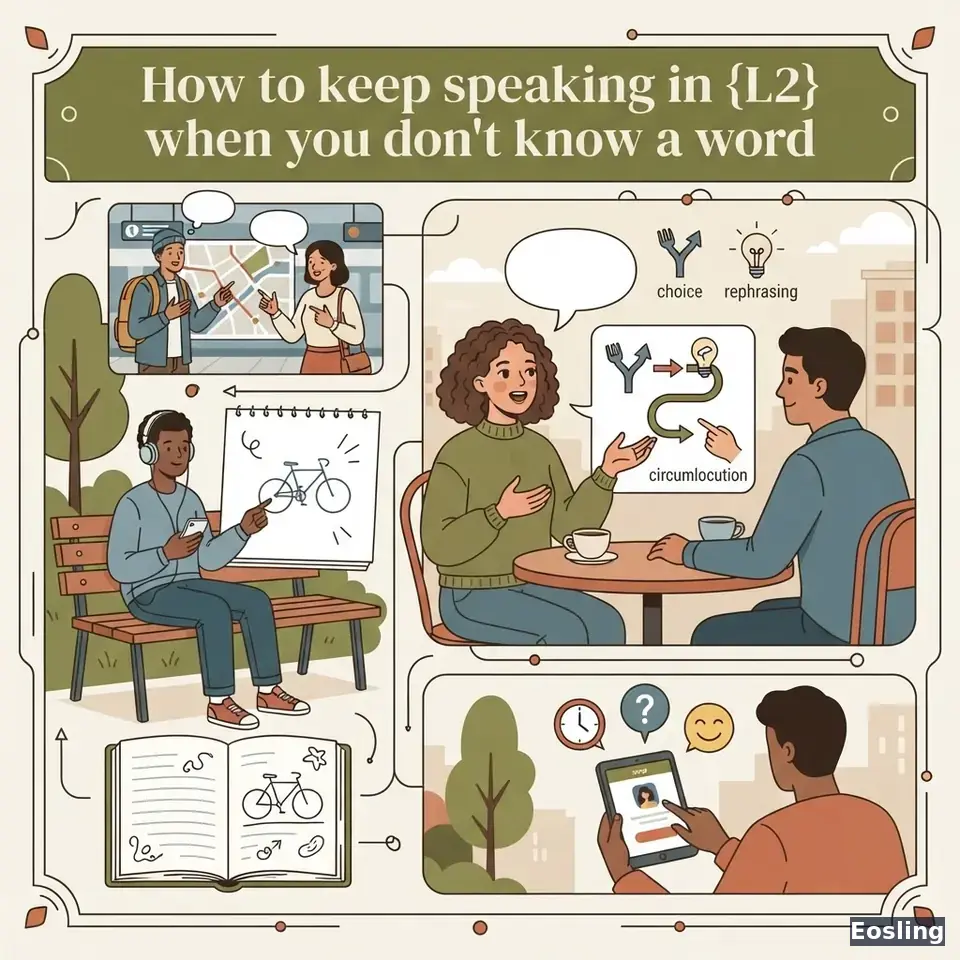
Every Russian lesson has that moment: you're mid-sentence, the noun you need vanishes, and you stop dead. I've watched confident students turn to stone because they couldn't summon холодильник (fridge) or зóнтик (umbrella). Here's the thing I tell them — you don't need the perfect word, you need другúми словáми ("in other words"). If you want to learn Russian online and actually hold a conversation, communication is a skill of going around the gap, not through it.
Russian practice
Pronunciation practice
Listen to the phrase, repeat into the mic — your teacher analyzes the audio and gives a real pronunciation score with corrections and comments.
1 / 3
Привет, как дела?
hello, how are you?
Why do we freeze in the first place?
Most learners treat a missing word as a wall, not a detour. You've been trained to produce the correct form, so when ну́жное сло́во (the needed word) isn't there, the whole sentence feels broken — and you stop, apologise, switch to English. The fear is usually about grammar, not meaning: you're scared that Я не зна́ю, как э́то сказа́ть ("I don't know how to say this") sounds like failure. It isn't. Native speakers say it constantly.
The other trap is translation-thinking. You hunt for the English word's exact Russian twin instead of asking what the thing does. Холодильник is hard to recall; вещь, где мы храни́м еду́ ("the thing where we keep food") is easy. Same object, different route.
Explain it with the words you already have
This is where Russian gives you real tools. Describe purpose, appearance, or compare it to something familiar:
| English | Russian phrase | When to use it |
|---|---|---|
| the thing for… | вещь для… | describing an object's job |
| it's like… but… | э́то как…, но… | comparing to something known |
| in other words | дру́гими слова́ми | rephrasing on the spot |
| what is it called? | как э́то называ́ется? | asking for the word |
Notice как э́то называ́ется? — one short question that hands the problem to your listener without breaking the flow. And дру́гими слова́ми buys you a second attempt in the same breath.
Practise staying in everyday Russian conversation
Fluency under pressure is a muscle. Try this: pick five objects in your kitchen and describe each one aloud without naming it — Э́то вещь, кото́рая де́лает во́ду горя́чей (the thing that makes water hot). Then retell a short news story using only words you're sure of, deliberately swapping out anything shaky. Finally, drill your rescue phrases until they're automatic: Подожди́, сейча́с подберу́ сло́во ("wait, let me find the word"). In a real chat, that pause sounds thoughtful, not weak.
Comments
Article discussion: learner comments and Eosling teacher replies
Drop your emotions below — love, debates, even hate welcome. Comment 👇
Don't want to miss my reply? Leave your email — I'll send a copy.