 Turning passive Portuguese understanding into speaking · Ana · Eosling
Eosling Ana Blog Turning passive Portuguese understanding into speaking
From Understanding Portuguese to Actually Speaking It — Portuguese Lessons
You understand Portuguese but freeze when it's time to talk? Learn Portuguese online and get practical steps to start producing real sentences with confidence. Portuguese Lessons.
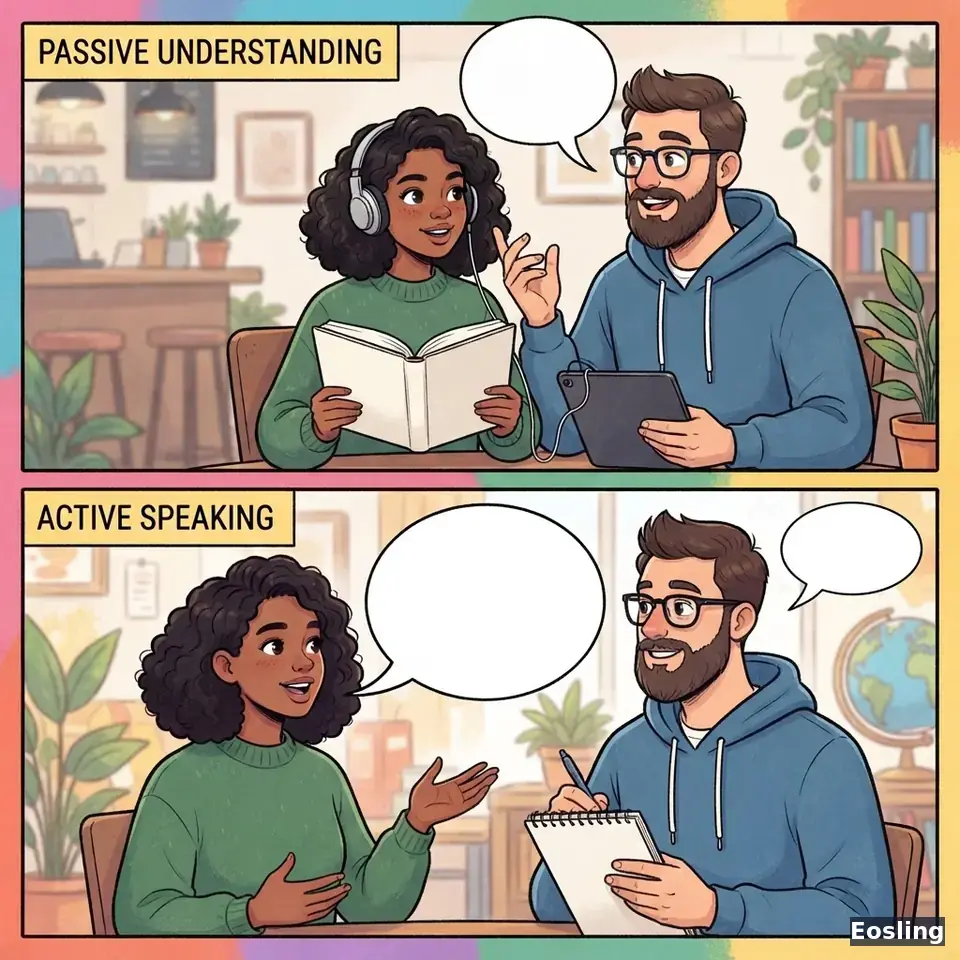
Students tell me this all the time: "I watch Brazilian series without subtitles, I read the news, I get it — but the moment someone asks me something, my mouth stops working." If that sounds familiar, you're not broken. Understanding
Portuguese practice
Pronunciation practice
Listen to the phrase, repeat into the mic — your teacher analyzes the audio and gives a real pronunciation score with corrections and comments.
1 / 3
Olá, tudo bem?
hello, how are you?
Think about what happens when you read
Why you understand but can't speak — Speak Portuguese like a local
Comprehension is forgiving. If you catch chegou you can guess the rest from context. Speaking has no context to lean on — you have to build the sentence from scratch. Three things usually get in the way.
First, retrieval speed. You know eu faria means "I would do," but pulling it out mid-conversation takes milliseconds you don't have yet. Second, sentence construction: Portuguese loves its little words — já, ainda, mesmo, a gente — and learners often freeze trying to place them correctly. Third, fear. You understood perfectly for months, so you expect your output to match. It won't, and that mismatch feels like failure.
| English | Portuguese you understand | What you must produce |
|---|---|---|
| I would go if I could | Eu iria se pudesse | Eu iria… (retrieve the conditional) |
| We've already eaten | A gente já comeu | A gente já… (pick the right past) |
| He was going to call | Ele ia ligar | Ele ia… (imperfect + infinitive) |
Turning what you understand into what you say
The bridge is repetition of whole chunks, not grammar drills. When you hear posso te ajudar?, don't just nod — say it back. Out loud. Then change one word: posso te ligar?, posso te perguntar?. You're not learning new grammar; you're moving a phrase from your ears to your mouth.
Comments
Article discussion: learner comments and Eosling teacher replies
Drop your emotions below — love, debates, even hate welcome. Comment 👇
Don't want to miss my reply? Leave your email — I'll send a copy.