 Ana · Eosling
How to Stop Translating in Your Head and Start Thinking in Portuguese — Learn To Speak Portuguese
Why your brain keeps translating English into Portuguese, when that habit helps, and practical drills to build direct thinking — learn Portuguese online. Learn To Speak Portuguese.
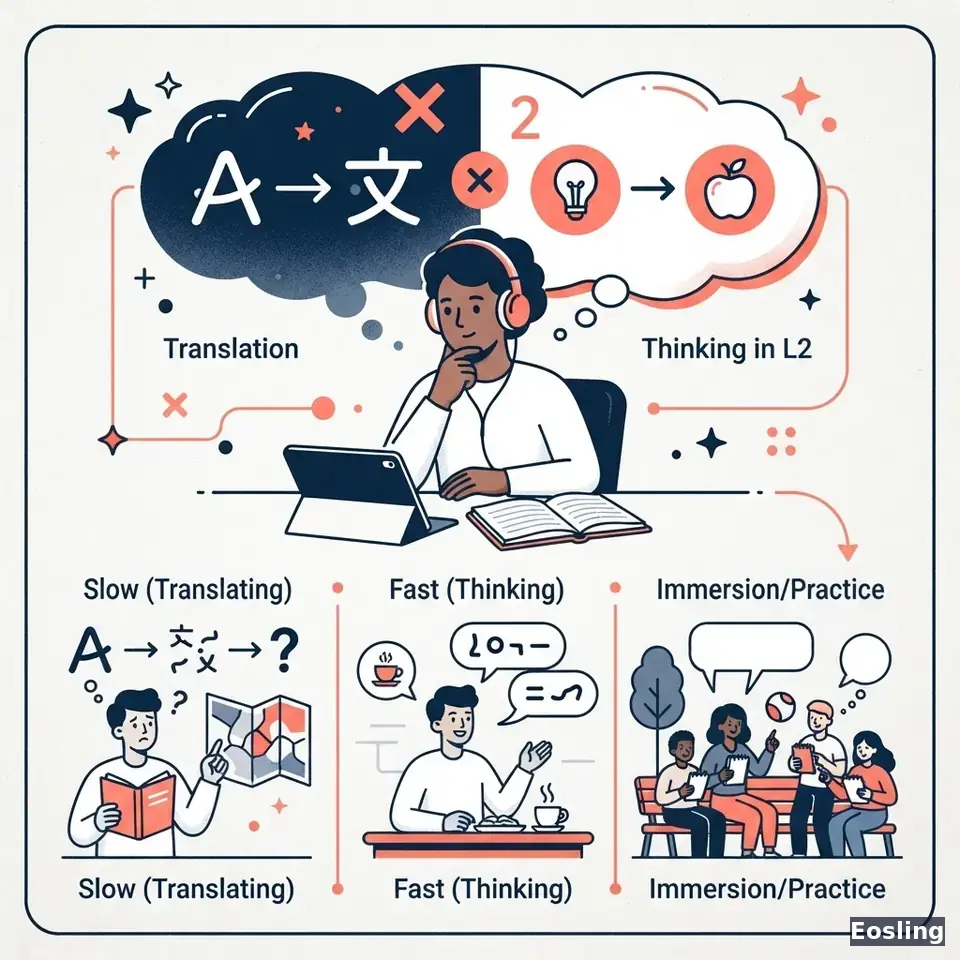
Every student I teach reaches the same wall. They want to say something simple — "I need to buy bread" — and instead of just saying it, I watch their eyes go up and left while they build the sentence in English first. The result is usually something like eu preciso comprar pão, technically perfect, but delivered two seconds too late. If you want to learn Portuguese online without that delay, the goal of this article isn't to ban English from your head. It's to shrink the gap between the thought and the Portuguese.
Portuguese practice
Pronunciation practice
Listen to the phrase, repeat into the mic — your teacher analyzes the audio and gives a real pronunciation score with corrections and comments.
1 / 3
Olá, tudo bem?
hello, how are you?
Why does the brain keep translating? — Everyday Portuguese conversation
Your native language is not a bad habit — it's the fastest retrieval system you own. When you need a word, English hands it to you instantly. Portuguese has to be searched for. So the brain does the sensible thing: it grabs the English concept and swaps words one by one.
The problem is that word-swapping works for concrete nouns and breaks down everywhere else. English says "I have to go," and a literal swap gives you eu tenho que ir — which is actually fine. But English "I am hungry" swapped literally becomes eu estou com fome… almost, except we say estou com fome without the pronoun, and Portuguese uses com where English uses "be." Automaticity, not translation, is what eventually makes that feel natural.
When translation helps, and when it gets in the way
Translation is a legitimate learning tool. As a beginner, checking that eu gosto de café really means "I like coffee" builds understanding. The trouble starts when translation becomes the only route to a sentence.
| English | Natural Portuguese | Literal swap that sounds off |
|---|---|---|
| I am 30 years old | Eu tenho 30 anos | Eu sou 30 anos |
| I miss you | Estou com saudade de você | Eu perco você |
| I have been studying | Eu estou estudando | Eu tenho estado estudando |
Notice the pattern: Portuguese uses ter for age, estar com for temporary states, and the present continuous where English uses the perfect. These aren't vocabulary gaps — they're structural ones, and no amount of word-swapping fixes them.
How to build direct thinking in Portuguese
Start with questions you can answer in two or three words, not full sentences. "O que você está bebendo?" — Café. "Onde você mora?" — Em São Paulo. No English, no full-sentence construction, just a direct response. This is where everyday Portuguese conversation begins to feel automatic rather than calculated.
Comments
Article discussion: learner comments and Eosling teacher replies
Drop your emotions below — love, debates, even hate welcome. Comment 👇
Don't want to miss my reply? Leave your email — I'll send a copy.