 Soo-jin · Eosling
Why You Understand Textbook Korean but Not Real Koreans — Speak Korean
A practical guide for English speakers learning Korean: why textbook dialogues sound nothing like real speech, and how to train your ears to follow natural Korean conversations. Speak Korean.
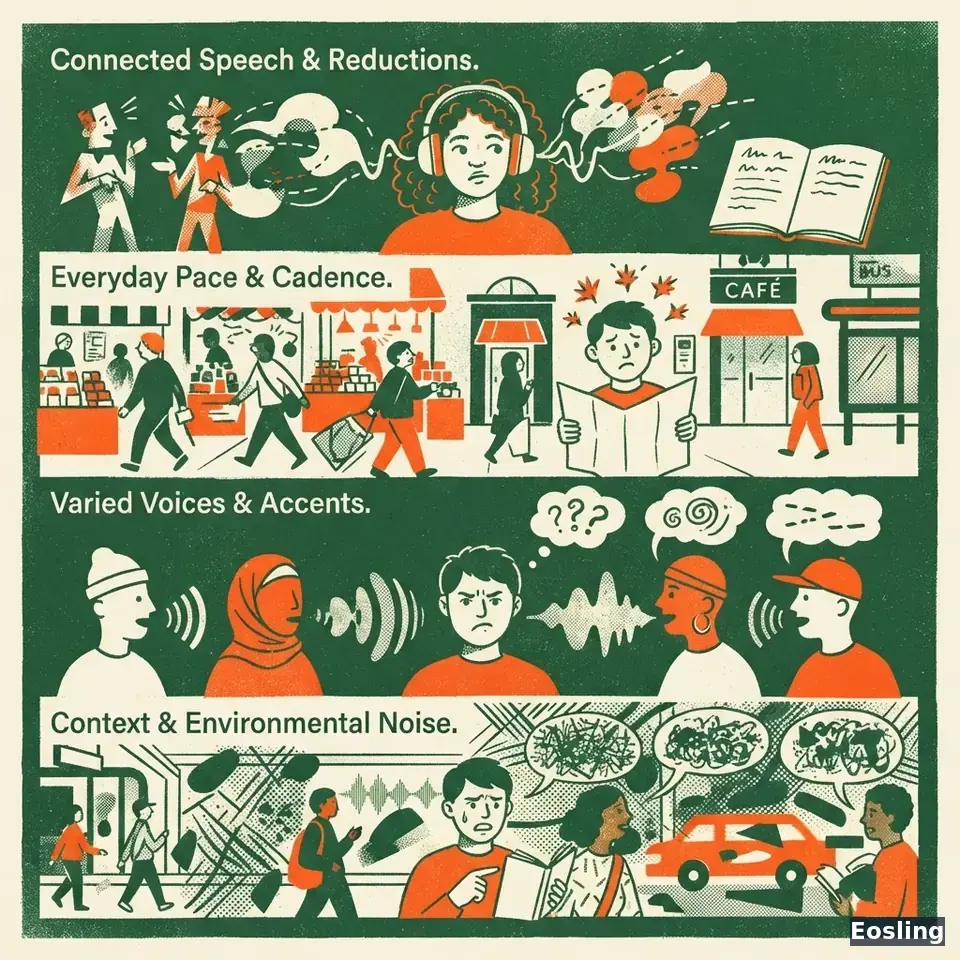
Every student hits this wall. You can read a textbook dialogue perfectly, you know 안녕하세요 and 감사합니다 by heart, and then a real Korean friend says something and you catch… nothing. Not one word. It's not that you forgot the language — it's that real speech runs on different rules. Korean textbooks teach careful, separated syllables; real Koreans blend, chop and reshape them. Let's fix that gap.
Korean practice
Pronunciation practice
Listen to the phrase, repeat into the mic — your teacher analyzes the audio and gives a real pronunciation score with corrections and comments.
1 / 3
안녕하세요, 잘 지내세요?
hello, how are you?
Why natural Korean is hard to catch — Speak Korean like a local
Korean has a set of sound rules that textbooks quietly ignore. Final consonants move onto the next syllable when a vowel follows: 한국어 is written han-guk-eo but said 한구거 (han-gu-geo). Consonants also soften between vowels: 감사합니다 becomes 감사함니다 in real mouths. Add the famous 먹었어요 turning into 머거써요, and you see the pattern — Korean compresses.
Speed and rhythm make it worse. Korean is syllable-timed with fairly even beats, but casual speech drops syllables entirely. 그것은 shrinks to 그건, 무엇을 to 뭘. And the verb sits at the end, so you can't guess meaning from the first word like you might in English — you wait for the ending, which carries tense and politeness all at once.
What your English ears expect (and shouldn't)
English trains you to hear stressed syllables as the "real" content: I WANT to GO. Korean doesn't work that way — particles like 은/는 and 이/가 are unstressed and slip past English ears as noise. English also links words with smooth consonants; Korean's tense consonants (ㄲ, ㄸ, ㅃ) and the three-way distinction between ㄱ/ㄲ/ㅋ are sounds English simply doesn't have, so your brain files them as "same sound."
| English habit | Works in Korean? | Watch out for |
|---|---|---|
| Stress = meaning | No | Particles are weak; listen to endings |
| Word-by-word parsing | No | Blending crosses word boundaries |
| Voiced vs voiceless pairs | Partly | 가/카/까 are three, not two |
Training your ears on purpose
Start with shadowing: play a short clip, then repeat it aloud immediately, matching the speed even if you don't understand everything. Next, listen to the same 10-second segment three times — once for gist, once to mark word boundaries, once to catch one specific ending like -는데 or -잖아요. Finally, slow the audio to 0.75x, then return to normal.
Real speech isn't a harder version of the textbook — it's a different system, and it's learnable. Ten focused minutes a day beats an hour of passive listening. Your ears just need the right reps.
Comments
Article discussion: learner comments and Eosling teacher replies
Drop your emotions below — love, debates, even hate welcome. Comment 👇
Don't want to miss my reply? Leave your email — I'll send a copy.