 Soo-jin · Eosling
How to Stop Translating in Your Head and Start Thinking in Korean — Learn To Speak Korean
Why your brain keeps translating English into Korean before you speak — and practical ways to learn Korean online and build direct Korean thinking without banning your native language. Learn To Speak Korean.
Every Korean learner knows the pause. You want to say something simple, and your brain runs a little assembly line: English sentence in, grammar check, Korean out. I still catch myself doing it with
Korean practice
Pronunciation practice
Listen to the phrase, repeat into the mic — your teacher analyzes the audio and gives a real pronunciation score with corrections and comments.
1 / 3
안녕하세요, 잘 지내세요?
hello, how are you?
Why does your brain keep translating? — Speak Korean like a local
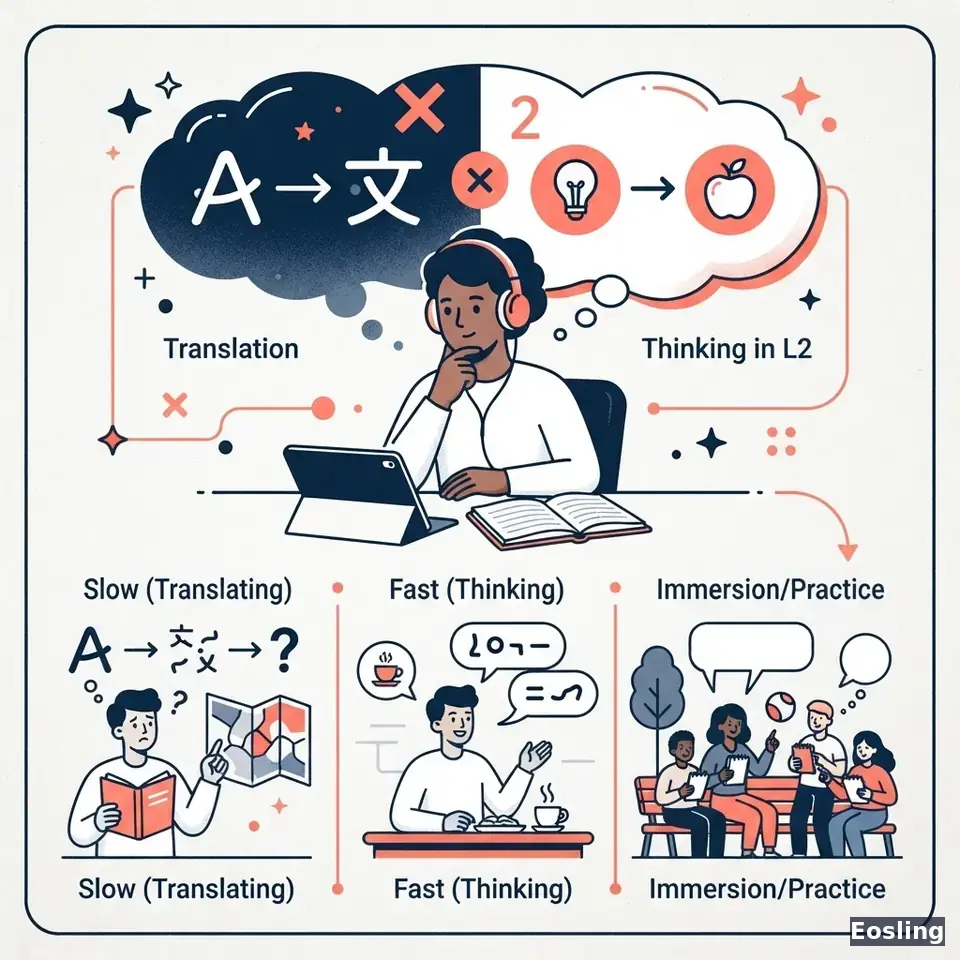
Your native language is the fastest road your brain knows. When you need a word, English hands it over instantly; Korean has to be searched for. So the brain takes a shortcut — grab the English meaning, then hunt for the Korean match. That's vocabulary retrieval, and it's slow by nature.
Sentence construction adds a second layer. Korean puts the verb at the end and marks roles with particles, so you can't just swap words one-for-one. 저는 커피를 마셔요 is literally "I coffee drink" — your English brain wants to object. And automaticity, the point where a phrase arrives without effort, only comes from repetition. Beginners translate more because nothing is automatic yet; advanced learners translate less because whole chunks like 감사합니다 or 괜찮아요 have become single units.
When translation helps — and when it gets in the way
Translation is a genuinely useful learning tool. For beginners, checking a new word against English builds meaning fast, and understanding a grammar point in your own language saves hours of confusion. The trouble starts when you translate every sentence during a real conversation.
| English | Natural Korean | Word-for-word trap |
|---|---|---|
| I like Korean food | 저는 한국 음식을 좋아해요 | 나는 한국 음식을 좋아한다 (too formal/plain in speech) |
| Where are you going? | 어디에 가요? | 어디에 당신은 가고 있습니까? (stiff, unnatural) |
| I'm hungry | 배고파요 | 나는 배고픈 상태입니다 (translationese) |
| Please give me water | 물 좀 주세요 | 물을 주세요 제발 (wrong nuance) |
Notice what happens: the literal version is grammatically defensible but sounds like a textbook robot. Korean also drops subjects freely — 배고파요 needs no "I" — so English-style completeness actually makes you sound less natural.
Comments
Article discussion: learner comments and Eosling teacher replies
Drop your emotions below — love, debates, even hate welcome. Comment 👇
Don't want to miss my reply? Leave your email — I'll send a copy.