 Anna · Eosling
How to Stop Translating in Your Head and Start Thinking in German — Learn To Speak German
Why your brain keeps translating from English before you speak German — and practical ways to learn German online with more direct thinking, step by step. Learn To Speak German.
Almost every learner I meet apologises for the same thing: "I still translate everything from English before I say it in German." I always tell them the same thing — that's not a flaw, that's your brain doing its job. When you first learn to say Ich hätte gern einen Kaffee, you build it from an English sentence ("I would like a coffee"), not from a feeling. The good news is that this bridge is temporary, and it's exactly the kind of thing you work through when you learn German online — the goal isn't to ban English from your head, it's to need it less each month.
German practice
Pronunciation practice
Listen to the phrase, repeat into the mic — your teacher analyzes the audio and gives a real pronunciation score with corrections and comments.
1 / 3
Hallo, wie geht’s?
hello, how are you?
Why does your brain keep translating? — Speak German like a local
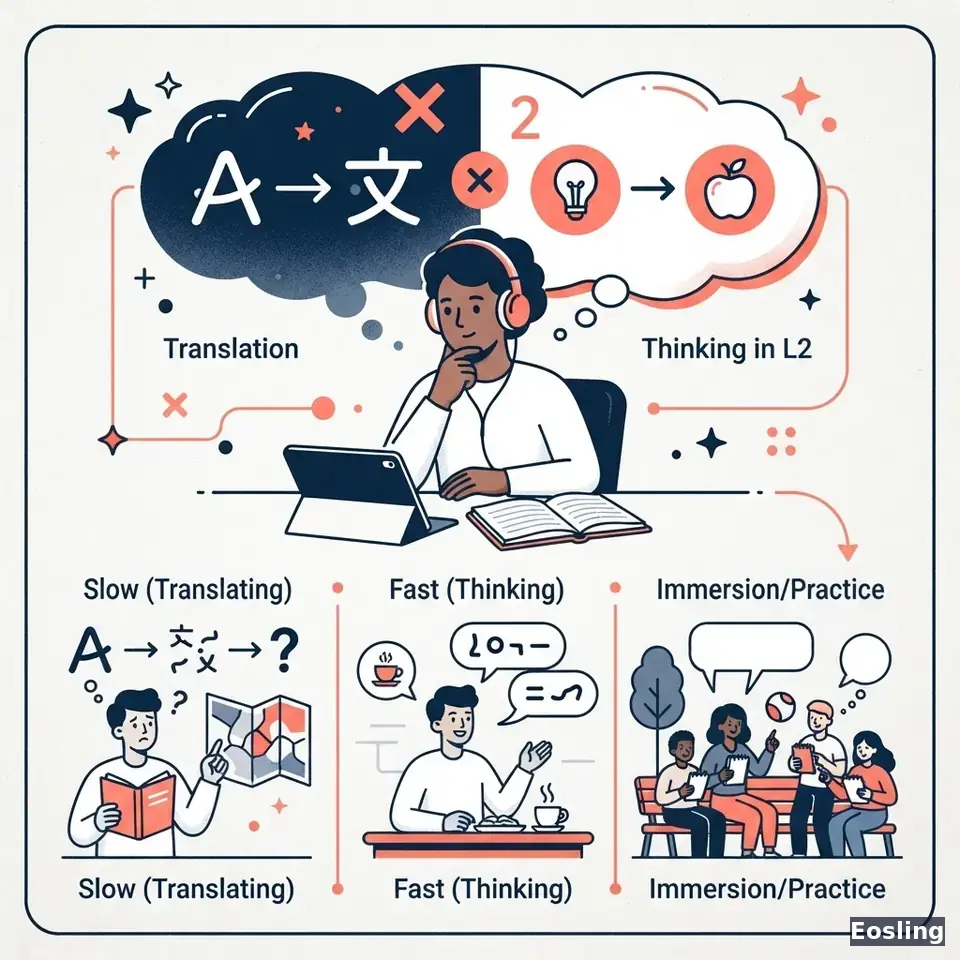
Your native language is the fastest route your brain knows. When you want to say something, it grabs the English meaning first, then searches for German words, then assembles the sentence — three steps instead of one. That's Vokabelabruf (vocabulary retrieval) plus grammar plus word order, all at once. It's slow because it's new.
The fix isn't willpower, it's Automatisierung — automaticity. The more often you produce a phrase like Ich bin müde or Das ist mir egal, the less your brain bothers consulting English. Beginners translate almost every word; at B1 you translate whole ideas; at B2 you often notice you simply reacted in German. That progression is normal, and it happens with use, not with a trick.
When translation helps — and when it gets in the way
Translation is a genuinely useful learning tool. For beginners, checking der, die, das or confirming that Ich freue mich auf das Wochenende means what you think it means saves you from fossilising mistakes. Writing a sentence in English first and then rebuilding it in German is good homework.
It gets in the way when it becomes a habit inside conversation. English and German don't line up neatly, and forcing a word-for-word match produces sentences that are grammatically fine but sound odd:
| English | Natural German | Word-for-word trap |
|---|---|---|
| I'm cold | Mir ist kalt | Ich bin kalt (sounds like "I'm a cold person") |
| I like the film | Der Film gefällt mir | Ich mag den Film (fine, but different flavour) |
| I'm looking forward to it | Ich freue mich darauf | Ich schaue vorwärts (nonsense) |
Comments
Article discussion: learner comments and Eosling teacher replies
Drop your emotions below — love, debates, even hate welcome. Comment 👇
Don't want to miss my reply? Leave your email — I'll send a copy.