 Surviving German gaps mid-sentence · Anna · Eosling
Eosling Anna Blog Surviving German gaps mid-sentence
How to Keep Speaking German When the Word Just Won't Come — German Lessons
Learn German online with practical strategies for keeping a conversation alive when you've forgotten a word — describe, compare, simplify, and ask instead of freezing. German Lessons.
Every German learner knows the moment: you're mid-sentence, the verb is coming, and the noun has vanished. You wanted to say the fridge, and now you're standing there with Ich habe… ähm… and a red face. I've watched hundreds of students do this, and the good news is that the conversation doesn't have to end there. Fluency isn't knowing every word — it's the skill of saying Das Ding, wo die Milch kalt bleibt ("the thing where the milk stays cold") and moving on. That sentence is not a failure. It's German working exactly as it should — and it's exactly what you practise when you learn German online with a focus on real communication.
German practice
Pronunciation practice
Listen to the phrase, repeat into the mic — your teacher analyzes the audio and gives a real pronunciation score with corrections and comments.
1 / 3
Hallo, wie geht’s?
hello, how are you?
Why we freeze — and why it's not a vocabulary problem
When a word goes missing, most learners do one thing: they hunt for it. The brain keeps digging in the same hole, the sentence stalls, and the silence grows louder than the mistake ever would. Underneath that hunt is usually a quiet belief that a sentence with a gap is a broken sentence — that Ein Kaffee, bitte only counts if it's grammatically tidy and complete.
It also has a lot to do with word order. In German, the sentence isn't finished until the end, so learners often feel they can't stop halfway. But you can. You're allowed to say Ich möchte… also, ich hätte gern… and restart. Native speakers do this constantly — Wie heißt das noch mal? is not a beginner's phrase, it's everyday German.
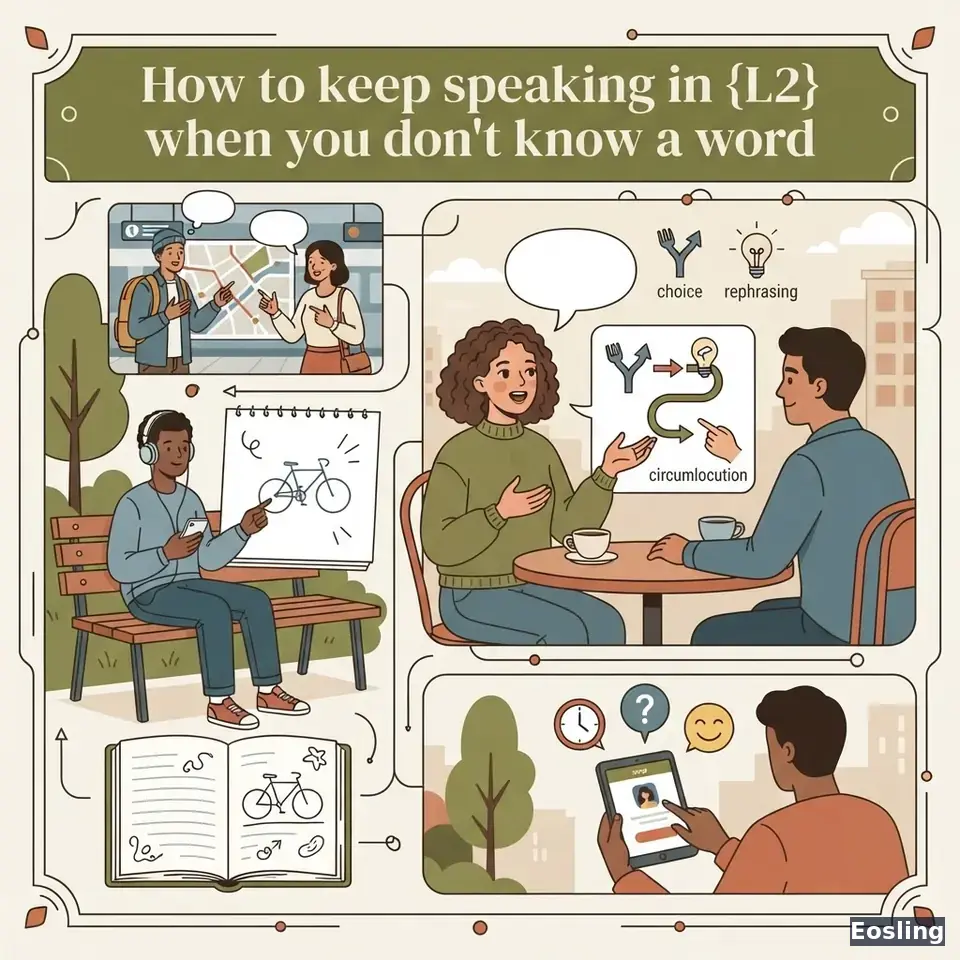
The real issue is that we treat the missing word as the whole task. It isn't. The task is being understood, and there are at least four ways around a gap.
Explaining an idea with the German you already have
The trick is to stop searching for the noun and start describing it. Here are the moves I teach first, with the honest English meaning behind each one.
| English | German phrase | When to use it |
|---|---|---|
| It's a thing you use to… | Das ist so ein Ding, mit dem man… | You know the function but not the name |
| It's like a…, but… | Das ist wie ein…, aber kleiner | You can compare it to something familiar |
| I mean something like… | Ich meine so etwas wie… | You need a rough category, not precision |
| What do you call that? | Wie sagt man das? | You want the word, not a workaround |
| Do you know what I mean? | Weißt du, was ich meine? | You want a quick check-in |
Comments
Article discussion: learner comments and Eosling teacher replies
Drop your emotions below — love, debates, even hate welcome. Comment 👇
Don't want to miss my reply? Leave your email — I'll send a copy.