 Ananya · Eosling
How to Stop Translating in Your Head and Start Thinking in Bengali — Learn To Speak Bangla
Why your brain keeps translating, when it actually helps, and simple drills to build direct thinking — learn Bangla online at your own pace. Learn To Speak Bangla.
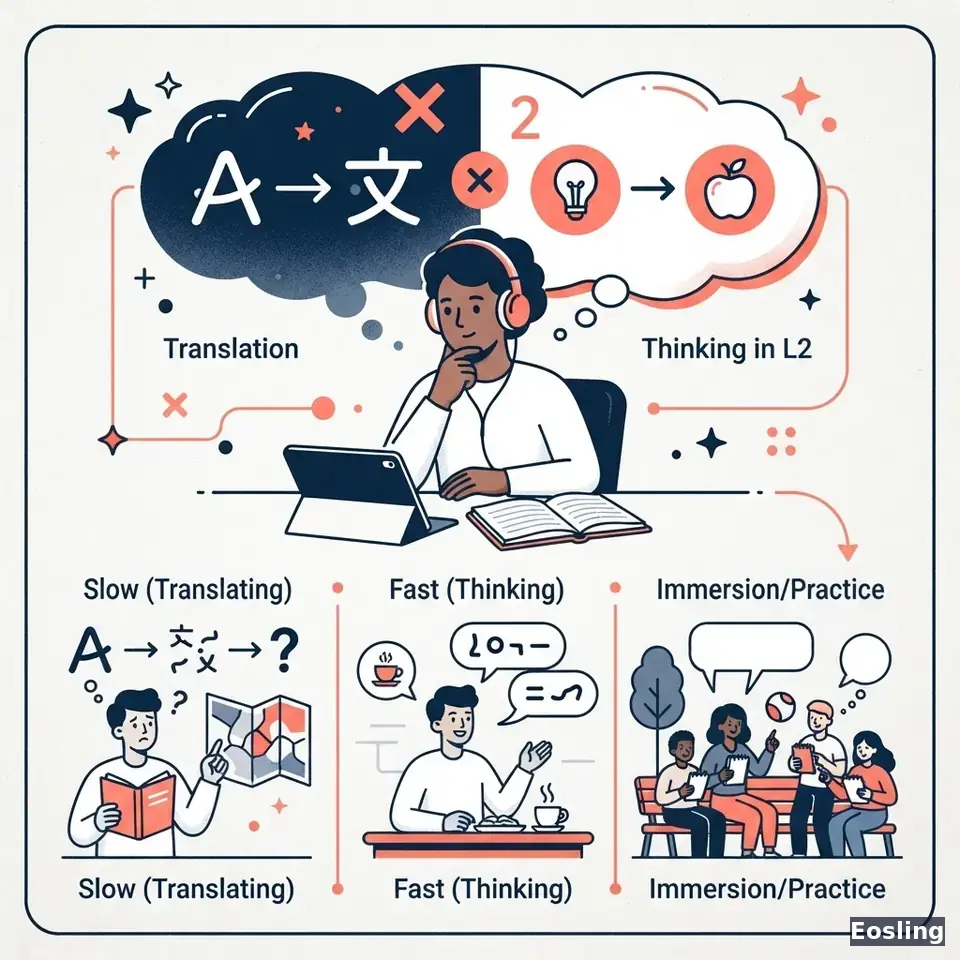
Every English speaker who learns Bengali hits the same wall: you want to say something simple, and your brain runs a little translation engine first — "I am going to the market" becomes আমি বাজারে যাচ্ছি, word by word, before it leaves your mouth. That pause is normal, and it is not a sign you are bad at the language. It is just your brain taking the safest route it knows. If you learn Bangla online, the goal is not to switch that engine off forever, but to make it quieter when you actually need to speak.
Bengali practice
Pronunciation practice
Listen to the phrase, repeat into the mic — your teacher analyzes the audio and gives a real pronunciation score with corrections and comments.
1 / 3
নমস্কার, কেমন আছেন?
hello, how are you?
Why does the brain keep translating? — Speak Bangla like a local
Your native language is a deeply wired shortcut. When you reach for a Bengali word, your memory first offers the English concept, then hunts for its Bengali label — that is vocabulary retrieval, and it is slow until a word has been used many times. Sentence construction adds a second delay: English is Subject–Verb–Object, Bengali is Subject–Object–Verb, so "I eat rice" has to be reshuffled into আমি ভাত খাই. Automaticity — the point where a form arrives without effort — only comes from repetition, not from understanding grammar rules. Beginners translate more because every word is still new; intermediate learners translate less because chunks like আমি যাচ্ছি or আমি খেয়েছি start arriving as single units.
When does translation help, and when does it get in the way?
Translation is a genuinely useful learning tool, especially early on. Checking that আমি খেয়েছি really means "I have eaten" builds accurate understanding, and comparing structures side by side is how you notice what Bengali does differently.
| English | Bengali | Watch out for |
|---|---|---|
| I eat rice | আমি ভাত খাই | Verb goes last, not second |
| I am eating | আমি খাচ্ছি | Continuous has its own ending |
| You are going | তুমি যাচ্ছ | Ending changes with person and politeness |
| Where are you going? | তুমি কোথায় যাচ্ছ? | Question word sits before the verb |
The trouble starts when you translate every sentence during a real conversation. Bengali verb endings already carry person and tense, so building the English sentence first and then converting it doubles your work — and produces stiff phrasing. Politeness levels are another trap: choosing between তুমি, আপনি and তুই is a social decision, not a grammar swap, and no English sentence tells you which one fits.
Comments
Article discussion: learner comments and Eosling teacher replies
Drop your emotions below — love, debates, even hate welcome. Comment 👇
Don't want to miss my reply? Leave your email — I'll send a copy.