 Passive Bengali comprehension to active speaking practic · Ananya · Eosling
Eosling Ananya Blog Passive Bengali comprehension to active speaking practic
From Understanding to Speaking Bengali: A Practical Bridge — Bangla Lessons
You follow Bengali conversations yet freeze when it's your turn to speak. Learn Bangla online and close the gap between understanding and speaking, step by step. Bangla Lessons.
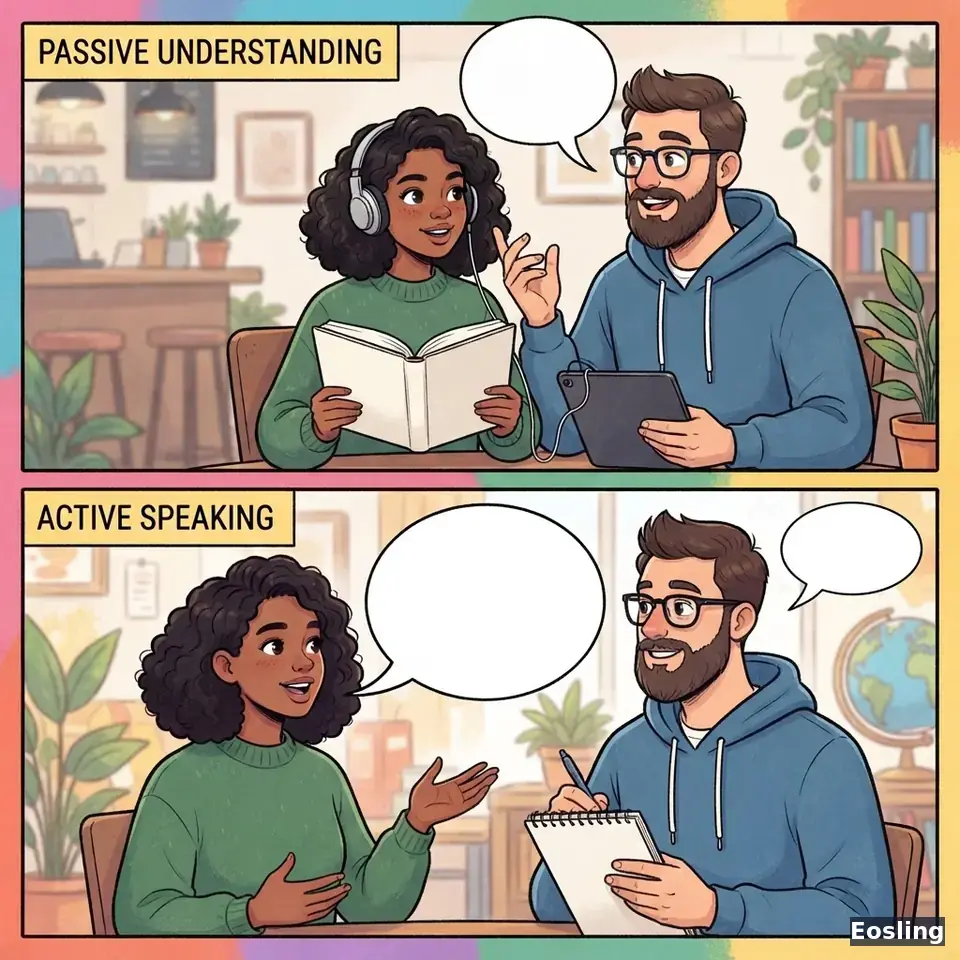
Every Bengali learner I teach hits the same wall. You nod along when someone says
Bengali practice
Pronunciation practice
Listen to the phrase, repeat into the mic — your teacher analyzes the audio and gives a real pronunciation score with corrections and comments.
1 / 3
নমস্কার, কেমন আছেন?
hello, how are you?
Why you understand Bengali but can't speak it yet — Everyday Bangla conversation
Recognition is cheap; retrieval is expensive. When you hear আমি ভাত খাই (I eat rice), your brain matches a pattern it has seen before. But to say it yourself, you must pull খাই from memory, check the verb ending matches আমি, and place it after the object — all in under a second. That's a lot of simultaneous work.
Bengali adds its own hurdles for English speakers. The verb sits at the end, so you can't build a sentence left to right like English. Verb endings shift with politeness and person: আমি যাই (I go), আপনি যান (you go, polite), সে যায় (he/she goes). And word order flips: English "I eat rice" becomes আমি ভাত খাই, literally "I rice eat."
| English | Bengali | Common slip |
|---|---|---|
| I eat rice | আমি ভাত খাই | putting খাই too early |
| You go (polite) | আপনি যান | using যাও with elders |
| She reads a book | সে বই পড়ে | forgetting the -ে ending |
None of this means you're bad at Bengali. It means your passive store is rich and your active store is thin. Fear of choosing the wrong ending makes it worse — you rehearse silently, miss the moment, and feel defeated.
Turning what you understand into what you can say
Start with phrases you already recognise, not new grammar. Repeat আমি ভালো আছি aloud ten times until it needs no thought. Then retell a short message in simpler words: if someone says আজ আমি অফিসে যাবো না, you reply আজ আপনি অফিসে যাবেন না — same meaning, your voice.
Comments
Article discussion: learner comments and Eosling teacher replies
Drop your emotions below — love, debates, even hate welcome. Comment 👇
Don't want to miss my reply? Leave your email — I'll send a copy.