 Layla · Eosling
How to Stop Translating in Your Head and Start Thinking in Arabic — Learn To Speak Arabic
Why your brain keeps translating English into Arabic before you speak — and practical ways to build direct Arabic thinking. Learn Arabic online with confidence. Learn To Speak Arabic.
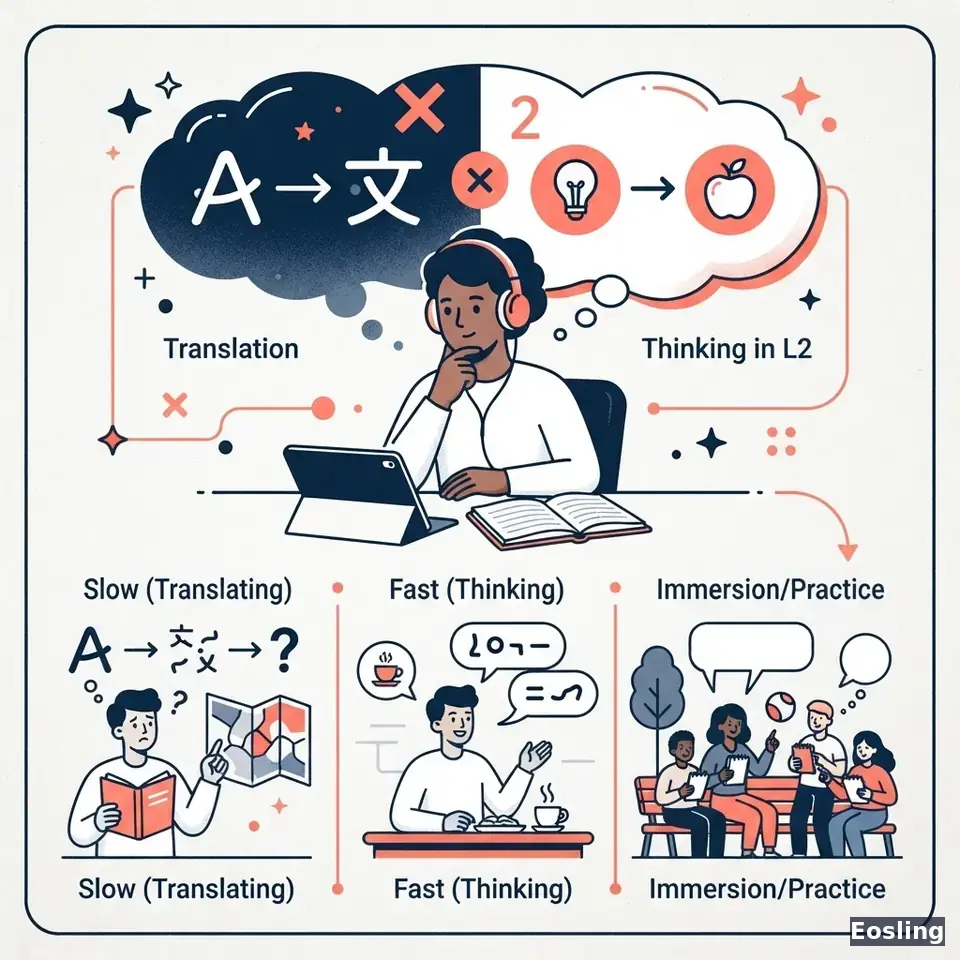
Every Arabic learner knows the pause. You want to say something simple, but between the thought and the sentence there's a busy little translator whispering English first. I did it for years with English, so no judgement here. The good news: that pause shrinks, and if you learn Arabic online with steady practice, it shrinks faster than you'd expect. You start reaching for أريد قهوة instead of assembling "I want" + "coffee" + grammar check. You begin to feel that أنا ذاهب إلى البيت is just one thought, not three puzzle pieces.
Arabic practice
Pronunciation practice
Listen to the phrase, repeat into the mic — your teacher analyzes the audio and gives a real pronunciation score with corrections and comments.
1 / 3
مرحبا، كيف حالك؟
hello, how are you?
Why does the brain keep translating? — Speak Arabic like a local
Your native language is the filing system you built for twenty-plus years. When you need a word in Arabic, the fastest route your brain knows is: concept → English word → Arabic equivalent. That's not laziness, it's efficiency. Beginners lean on it because their Arabic vocabulary is still thin and retrieval is slow.
Arabic makes this extra tempting because so little maps one-to-one. English "I want" is one word; Arabic splits by speaker: أريد for me, تريد for you, يريد for him. English "I don't know" becomes لا أعرف — a negation particle plus a conjugated verb, not a swapped "I do not know". If you translate word by word, you produce correct-ish but stiff Arabic. Automaticity comes from repetition of whole chunks, not from faster translating.
When does translation help, and when does it get in the way?
Translation is a legitimate learning tool. As a beginner, checking that أنا ذاهب إلى البيت really means "I'm going home" builds confidence and catches mistakes. Grammar explanations in English save you hours.
The trouble starts when translation becomes the only route. In real conversation you have about a second, and a full translate-then-speak pipeline eats it. Arabic word order also fights the English habit: في البيت كتاب puts the location first, and questions like هل تريد شاي؟ don't mirror English structure at all.
| English habit | Natural Arabic | Why it trips you |
|---|---|---|
| "I want coffee" word by word | أريد قهوة | One conjugated verb, no separate pronoun |
| "Do you want tea?" | هل تريد شاي؟ | Question particle هل, verb agrees with listener |
| "There is a book in the house" | في البيت كتاب | Location precedes the thing |
| "I don't know" | لا أعرف | Negation + verb, not "I do not" |
How do you start thinking directly in Arabic?
Build small bridges, not a demolition crew. Try these:
Comments
Article discussion: learner comments and Eosling teacher replies
Drop your emotions below — love, debates, even hate welcome. Comment 👇
Don't want to miss my reply? Leave your email — I'll send a copy.