 Staying fluent in Arabic without the exact word · Layla · Eosling
Eosling Layla Blog Staying fluent in Arabic without the exact word
How to Keep Speaking Arabic When You Don't Know a Word — Arabic Lessons
Practical strategies to keep an Arabic conversation going when a word escapes you — describe, compare, simplify, and ask for help without freezing up. Arabic Lessons.
Every Arabic learner knows the moment: you're mid-sentence, the other person is nodding, and then the word you need — the only word that fits — vanishes. Your mouth stays open, the sentence dangles, and you feel the conversation slip away. I've watched students freeze over a missing word for مِفْتَاح (key) or مِرْوَحَة (fan) as if the whole exchange depended on it. It doesn't. Real communication is a toolbox, not a dictionary, and in Arabic you have some wonderfully simple tools for talking your way around a gap.
Arabic practice
Pronunciation practice
Listen to the phrase, repeat into the mic — your teacher analyzes the audio and gives a real pronunciation score with corrections and comments.
1 / 3
مرحبا، كيف حالك؟
hello, how are you?
Why do we freeze in the first place? — Speak Arabic like a local
Most freezing isn't a language problem — it's a focus problem. You've decided that this exact word is the only acceptable answer, so you stop producing anything at all. Add a fear of sounding foolish, and the silence grows. But notice what native speakers actually do: they rarely hunt for the perfect noun. They say شَيْءٌ مِثْل… ("something like…") and keep moving. That little phrase buys you time and keeps the floor. The goal is not a flawless sentence; it's a sentence that continues.
Explaining an idea with words you already have
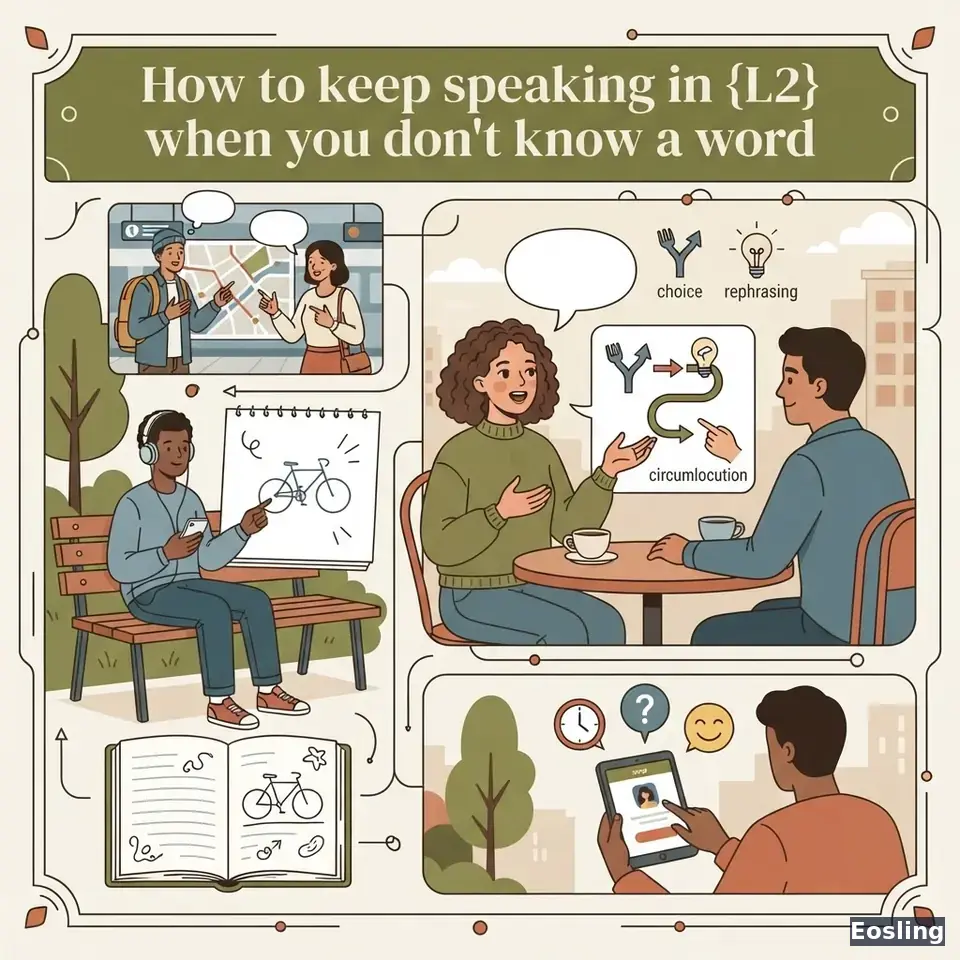
The trick is to describe instead of naming. Talk about shape, colour, or purpose, or compare the thing to something familiar. If you forget the word for "kettle," say إِنَاءٌ لِلْمَاءِ السَّاخِن ("a container for hot water") — it's not elegant, but it works. When you need a breather, ask a short question. Here are the phrases I drill most often:
| English | Arabic phrase | When to use it |
|---|---|---|
| Something like… | شَيْءٌ مِثْل… | buying time while you think |
| I use it to… | أَسْتَخْدِمُهُ لِ… | explaining an object's purpose |
| How do you say…? | كَيْفَ تَقُول…؟ | asking for the missing word |
| It's the opposite of… | هُوَ عَكْسُ… | defining by contrast |
Notice that none of these require the word you're missing. And asking كَيْفَ تَقُول…؟ is not cheating — it's a real skill, and native speakers answer it happily.
Practising the art of staying in the conversation
You build this muscle the same way you build any other: small, repeated reps. Try describing an everyday object in Arabic without naming it, and let a friend guess. Retell a short story you know using only vocabulary you're sure of. Practise one clarification phrase until it's automatic, so it appears before panic does. And keep your dictionary nearby — just reach for it after you've tried a workaround, not before. That order matters.
Comments
Article discussion: learner comments and Eosling teacher replies
Drop your emotions below — love, debates, even hate welcome. Comment 👇
Don't want to miss my reply? Leave your email — I'll send a copy.